
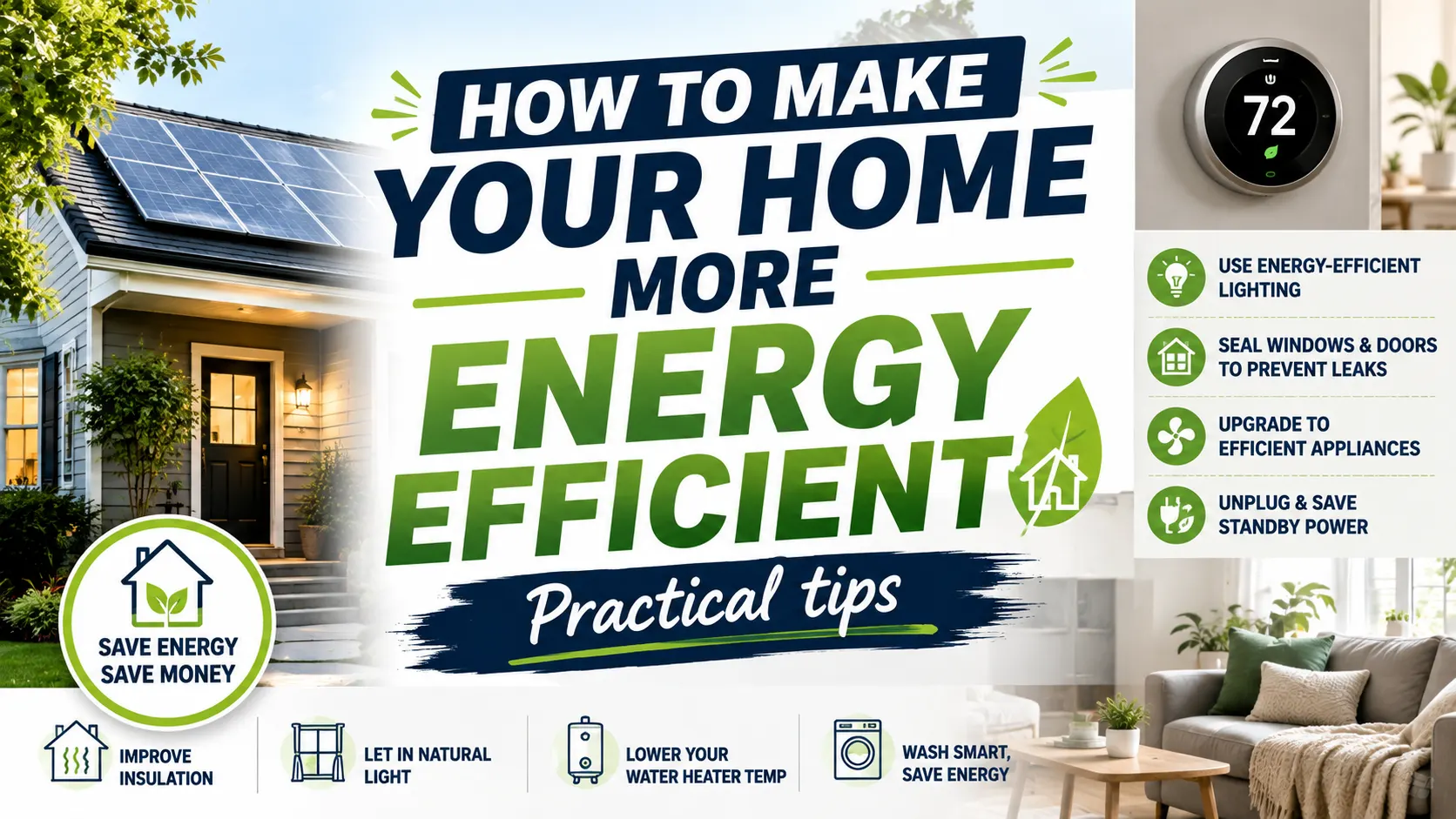
I still remember opening my electric bill one August and doing a double take. It was almost double what I’d paid the year before, and I hadn’t changed a single thing about how I lived. Same thermostat setting, same appliances, same habits. That bill sent me down a rabbit hole of research, and honestly, most of what I found online was either too vague to act on or so technical it felt like I needed an engineering degree just to change a light bulb.
So this is the version I wish I’d found first. No jargon, no assumptions that you’re about to gut-renovate your house. Just practical changes, starting with the ones that cost nothing and moving up from there.
Start With What’s Actually Costing You Money
Before you spend a cent on new equipment, it helps to know where your energy is actually going. For most homes, heating and cooling eat up the biggest chunk of the bill, followed by water heating, then appliances and lighting. That order matters, because it tells you where to focus first. There’s no point agonizing over whether to unplug your toaster when your attic insulation is doing next to nothing.
If your utility company offers a free home energy audit, take them up on it. A lot of people skip this step because it sounds like a hassle, but it usually takes under an hour and tells you exactly where you’re losing energy, sometimes in places you’d never think to check.
Seal the Gaps You’re Not Thinking About
This was the one that actually moved the needle for me, and it cost about fifteen dollars.
Doors and windows get all the attention when people talk about drafts, but a huge amount of air leaks happen in places nobody thinks to check: where pipes enter the wall under your sink, around electrical outlets on exterior walls, gaps where your dryer vent goes outside, the attic hatch, recessed lighting fixtures. I went around my house with a stick of incense on a slightly windy day and watched where the smoke got pulled sideways. It sounds a little ridiculous, but it works, and it’s free.
For anywhere you find a draft:
- Outlets and switch plates on exterior walls – foam gasket inserts go behind the cover plate and take about two minutes each
- Gaps around pipes and cables – a bit of caulk or expanding foam seals these permanently
- Attic hatch or pull-down stairs – weatherstripping around the frame makes a bigger difference than most people expect
- Baseboards along exterior walls – caulk here if you can see daylight or feel air movement
None of this requires a contractor. It’s an afternoon with a caulk gun.
Get Your Thermostat Working For You, Not Against You
If you’re still manually adjusting your thermostat throughout the day, you’re leaving savings on the table without realizing it. The biggest energy waster in most homes isn’t that the heating or cooling runs too much, it’s that it runs at full strength when nobody actually needs it to.
A programmable or smart thermostat lets you set it back automatically while you’re asleep or out of the house, then have it return to a comfortable temperature right before you need it. Even without a smart thermostat, a rule of thumb works nearly as well: for every degree you adjust your thermostat back over an 8-hour period, you can expect a small but real reduction in that portion of your energy use. It adds up faster than people expect.
One thing I’d add from experience: don’t crank the thermostat way down (or up) thinking it’ll heat or cool the house faster. It won’t. Most systems run at the same speed regardless of the target temperature, so all you’re doing is overshooting and wasting energy.
Rethink How You’re Using Water Heating
Your water heater is quietly running in the background all day, whether you’re using hot water or not. A few adjustments here go a long way:
- Lower the temperature. Most water heaters are set to 140°F by default, but 120°F is plenty for most households and cuts down on both energy use and scalding risk.
- Insulate the tank and the first few feet of pipe coming out of it, especially if your water heater lives in an unheated basement or garage. Insulation sleeves are cheap and take twenty minutes to install.
- Fix drips. A dripping hot water faucet isn’t just wasting water, it’s wasting the energy that heated it in the first place.
Let Your Appliances Work Smarter
You don’t need to replace anything to see a difference here, just change a few habits:
- Run the dishwasher and washing machine with full loads only. Half-loads use nearly the same amount of energy as full ones.
- Wash clothes in cold water when possible. Most of the energy your washing machine uses goes toward heating water, not the actual washing motion.
- Air dry when you can. Even air-drying part of a load and finishing it in the dryer cuts down on runtime.
- Clean your dryer’s lint trap every load. A clogged trap makes the dryer work harder and take longer, which is an easy one to forget.
Let There Be (the Right Kind of) Light
If you still have incandescent bulbs anywhere in your house, this is the easiest win on this entire list. Swapping them for LED bulbs typically cuts the energy used for that fixture dramatically, and LEDs last years longer, so you’re not constantly replacing them either.
Pair this with simply turning lights off in rooms you’re not using, it sounds obvious, but it’s usually the first habit that slips once life gets busy.
Don’t Underestimate Your Windows
You don’t need to replace your windows to get more out of them:
- Curtains matter more than people think. Heavy curtains keep heat in during winter; light-colored, reflective curtains help keep it out in summer. Close them accordingly based on the season and time of day.
- Check for leaks around the frame, not just the sash. Old caulk cracks over time and lets air through even if the window itself seals fine.
- Use a door snake or draft stopper for exterior doors if you notice cold air pooling near the bottom.
The Small Stuff That Adds Up
A few habits that don’t fit neatly into a category but genuinely help:
- Unplug chargers and electronics when not in use, many devices draw a small amount of power even when switched off (often called phantom load)
- Use ceiling fans to help distribute heated or cooled air more evenly, so your system doesn’t have to work as hard
- Keep your HVAC filters clean, a clogged filter makes your whole system work harder for the same result
- Plant shade trees or use exterior shading on the side of your house that gets the most direct sun, if you’re thinking longer term
Final Thoughts
None of this required a major renovation or a big upfront investment, and that was kind of the point. Most homes are losing energy in small, unglamorous ways: a draft here, a slightly-too-high water heater setting there, a habit that quietly costs more than it needs to. Fix a handful of these, and you’ll likely notice the difference on your next bill without ever feeling like you sacrificed comfort to get there.