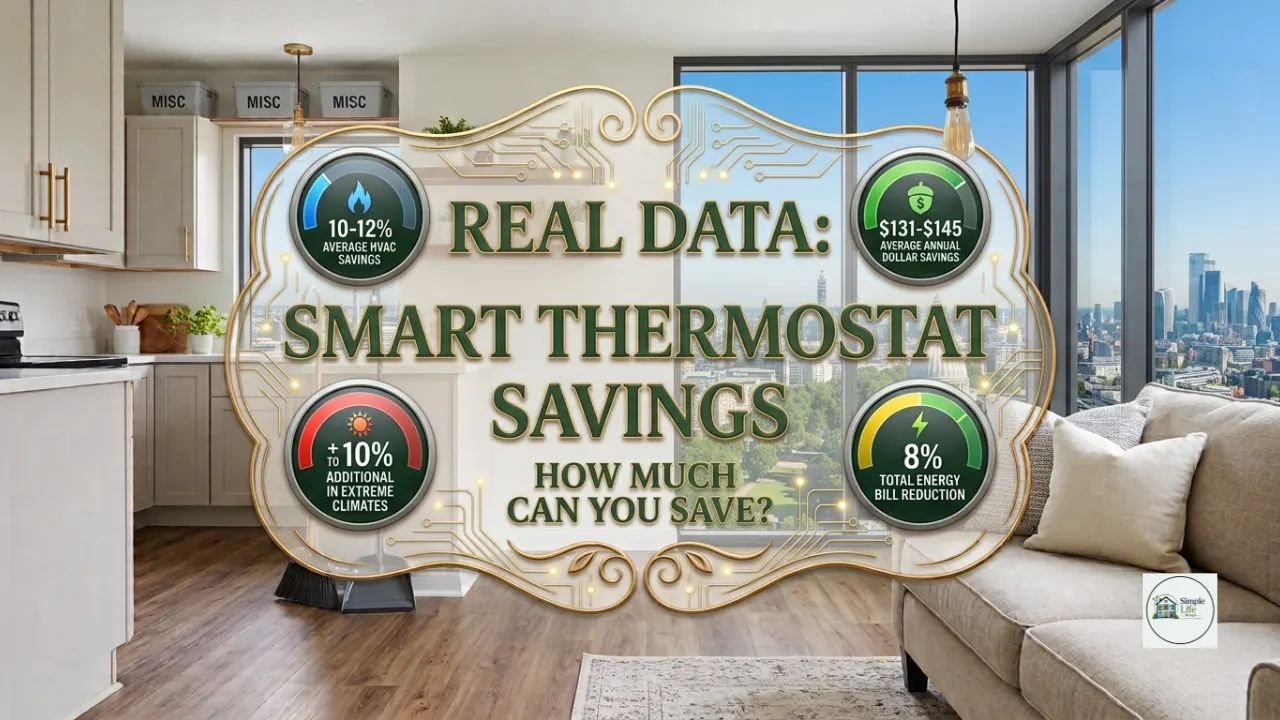
Quick answer: A smart thermostat typically saves between 8% and 15% on heating and cooling costs, which works out to roughly $50 to $145 per year for the average U.S. household. ENERGY STAR-certified models average around 8% in combined savings, or about $50 annually, while independent studies on the Nest Learning Thermostat found average savings of 12% on heating bills and 15% on cooling bills. Real-world savings vary based on your climate, your HVAC system, and how wastefully you were running your thermostat before switching.
That’s the short version. Here’s what actually determines where you’ll land in that range, and why the number on the box isn’t always the number on your bill.
The Real Numbers, Not Just the Marketing Claims
Every smart thermostat brand advertises big savings percentages, but not all of those numbers come from the same kind of research. It’s worth knowing the difference between a lab estimate and a measured field study before you decide how much to expect.
| Source | Reported Savings | Estimated Annual Dollar Savings |
|---|---|---|
| ENERGY STAR (certified models) | ~8% on heating & cooling | ~$50/year |
| Nest / Google (independent studies) | 10–12% heating, 15% cooling | $131–$145/year |
| Ecobee (company-reported) | ~23% combined | Varies by household |
| Pacific Gas & Electric field trial | 8.5–11.3% depending on heating type | Varies by household |
| Florida Solar Energy Center (field study) | ~9.3% cooling, 9.5% heating | Varies by household |
A pattern shows up once you compare manufacturer claims against independently measured, weather-normalized field data: real houses measured in field studies tend to show savings closer to 9-10% on heating and cooling energy rather than the 20% often advertised, and roughly a third of homes that install one see close to no savings at all. That doesn’t mean smart thermostats don’t work, it means the savings depend heavily on your starting point.
Why Your Savings Might Be Higher or Lower Than Average
You’ll save more if:
- You currently never adjust your thermostat manually. Households that leave their system running at one set temperature and never touch it have the highest potential savings, up to around 23%.
- You have an irregular schedule or leave home frequently during the day, since geofencing and away-detection have more opportunity to kick in.
- You previously owned a programmable thermostat but never actually programmed it. Studies show only about 30% of programmable thermostat owners actually set schedules on them, according to Department of Energy data, leaving the rest running as basic manual thermostats.
- You live somewhere with extreme summers or winters, where heating and cooling make up a larger share of your total bill.
You’ll save less (or close to nothing) if:
- You already program your thermostat well. One utility evaluation of over 2,000 Nest installations found that 20% of participants saw little to no savings, mostly because they were already using their old programmable thermostat effectively.
- Your HVAC system is old or poorly maintained, since no thermostat can fix a duct leak or a dying furnace.
- Your home has poor insulation, meaning the heating and cooling system has to fight harder regardless of the schedule.
How Smart Thermostats Actually Create Savings
The savings don’t come from the device itself, they come from what it changes about how your HVAC system runs:
- Automatic scheduling. Instead of relying on you to remember to set it back at night or before leaving for work, the thermostat does it automatically, every day, without fail.
- Geofencing. Using your phone’s location, the thermostat can detect when you’ve left and shift into an “away” setting, typically setting the temperature back 5 to 8 degrees until you’re on your way home.
- Learning behavior. Some models study your habits over the first few weeks and adjust the schedule to match, rather than requiring you to program it manually.
- Usage reports. Seeing exactly how much your system runs each day tends to change behavior on its own, even without automation.
As a reference point, the Department of Energy estimates that setting your thermostat back 7 to 10 degrees for 8 hours a day saves approximately 10% per year on heating and cooling, which is roughly what a smart thermostat automates for you without any daily effort.
Is It Worth the Cost? A Simple Payback Example
Smart thermostats typically run $130 to $250. Here’s how payback plays out using a conservative savings estimate:
If your annual heating and cooling costs are $1,200 and you save a modest 10%, that’s $120 back per year. A $200 thermostat pays for itself in under two years, and every year after that is straightforward savings. Because energy rates tend to rise an average of 2.5% to 3% annually, those yearly savings actually grow over time rather than staying flat.
One more thing worth checking before you buy: many utility companies offer rebates of $25 to $100 for installing an ENERGY STAR certified smart thermostat, which can cut your upfront cost significantly and shorten the payback period even further. It’s worth a quick search for your utility provider’s name plus “smart thermostat rebate” before purchasing.
The Bottom Line
A smart thermostat isn’t a guaranteed 20% cut to your energy bill, that number belongs on a marketing page, not a receipt. But for most households, especially ones that were previously running their heating and cooling on a fixed, unmanaged schedule, a realistic expectation is 8% to 15% in combined savings, with some households seeing more and a meaningful minority seeing very little. If you’re someone who already dials in your thermostat carefully, the device may pay for itself more slowly. If you’re someone who sets it once and forgets it exists, it’s one of the lowest-effort upgrades you can make to a home’s energy efficiency.