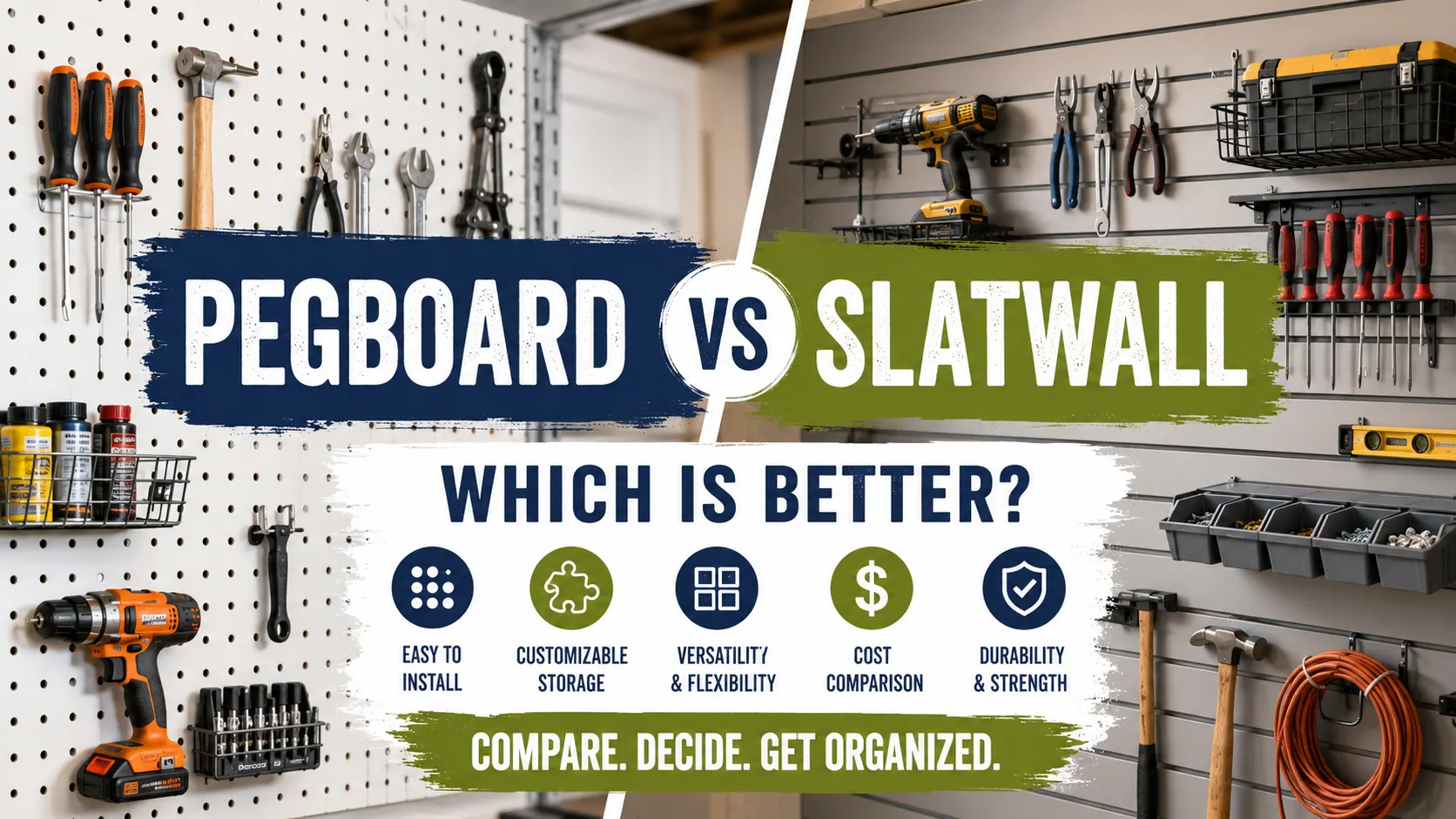
Quick answer: Pegboard is the better choice if you’re on a budget, organizing light hand tools or craft supplies, and want something you can set up in an afternoon. Slatwall is the better choice if you want a cleaner look, plan to hang heavier items, or want a system that holds up long-term without hooks shifting or holes wearing out. Most people who want the best of both use slatwall for the main wall and a small pegboard section for hand tools.
I get asked about this a lot whenever I write about garage or craft room organization, so I wanted to lay out exactly how these two systems compare, instead of just telling you “it depends.”
What’s the Difference?
Pegboard is a flat board — usually hardboard, but sometimes metal or plastic — with evenly spaced holes drilled through it. You hang hooks, baskets, and shelves directly into those holes.
Slatwall (sometimes called slotwall) is a panel with horizontal grooves running across it instead of holes. Hooks and accessories slide into the groove and lock in place, rather than sitting loose in a hole.
That one difference — holes versus grooves — is where basically everything else on this list comes from.
Pegboard vs Slatwall: Side-by-Side Comparison
| Pegboard | Slatwall | |
|---|---|---|
| Cost | Lower — a full sheet is inexpensive, and hooks are cheap | Higher — panels and matching hardware cost more upfront |
| Weight capacity | Light-duty — typically 5–25 lbs per hook | Heavy-duty — can hold significantly more per hook, and PVC/metal versions handle serious weight |
| Look | Basic, utilitarian, hardware-store appearance | Clean, polished, more like a finished room than a storage wall |
| Hook stability | Hooks sit in holes and can shift, tilt, or fall out with frequent use | Hooks lock into the groove and stay put |
| Moisture resistance | Poor for standard hardboard — can warp or swell in humid garages | Good, especially PVC versions — doesn’t absorb moisture the way hardboard does |
| Installation | Simple — light panels, basic tools, good first-time DIY project | More involved — heavier panels, more precise cutting around outlets and corners |
| Best for | Hand tools, craft supplies, light everyday items, tight budgets | Garages, workshops, heavier tools, spaces you want to look finished |
Where Pegboard Wins
- It’s cheap. A full sheet plus a basic set of hooks costs a fraction of what a slatwall system runs.
- It’s easy to set up yourself. Light panels and simple stud mounting make it one of the most beginner-friendly organization projects there is.
- It’s great for light, everyday items. Scissors, small tools, ribbon, craft supplies — anything light and frequently used works well on pegboard.
- You can outline your tools. Tracing a silhouette around each tool’s spot on pegboard is a classic trick for keeping things organized, and it’s something slatwall can’t really replicate.
Where Slatwall Wins
- It holds more weight. This is the biggest practical difference. If you’re hanging anything heavier than basic hand tools — power tool cases, bins full of supplies, bulkier equipment — slatwall handles it without sagging or pulling loose.
- The hooks actually stay where you put them. Because accessories lock into the groove instead of resting in a hole, you’re not constantly re-straightening things after grabbing something in a hurry.
- It holds up better over time, especially in a garage that gets humid. Standard hardboard pegboard can absorb moisture and warp; slatwall (particularly PVC) doesn’t have that problem.
- It looks more finished. If the space is somewhere you actually want to look nice — a craft room, a mudroom, a garage you spend real time in — slatwall reads as intentional rather than purely functional.
Which One Should You Actually Get?
Here’s how I’d think through it:
- Tight budget, light items, first organization project? Go with pegboard. It’s affordable, forgiving, and a great place to start.
- Heavier tools, a space you use constantly, or a garage that gets humid? Go with slatwall. The extra cost upfront saves you from replacing a warped, sagging board down the line.
- Want a space that actually looks good, not just functional? Slatwall wins here too — it has a cleaner, more finished appearance.
- Can’t decide? Do both. A lot of people use slatwall for the main wall and heavier items, then add a smaller pegboard section above a workbench for hand tools. You get the durability where it matters and the budget-friendly flexibility where it doesn’t.
Frequently Asked Questions
Is slatwall worth the extra cost over pegboard? If you’re storing anything heavier than light hand tools, or the space gets humid, yes — the weight capacity and moisture resistance make it hold up much longer. For light, low-traffic use, pegboard is perfectly fine and saves you money.
Does pegboard sag or wear out over time? Standard hardboard pegboard can bow or warp, especially in humid conditions, and the holes can widen or tear out with heavy or frequent use. Metal pegboard holds up better but costs closer to slatwall.
Can I mix pegboard and slatwall in the same space? Yes, and it’s a popular option. Many people use slatwall as the main system and add pegboard in a smaller, dedicated section for lighter items.
Which is easier to install, pegboard or slatwall? Pegboard is generally easier for a first-time DIY project — it’s lighter and more forgiving. Slatwall panels are heavier and require more precise measuring and cutting, especially around outlets and corners.
The Bottom Line
Neither system is “better” in every situation — it comes down to what you’re storing and how much you want to spend. Pegboard is the practical, budget-friendly choice for light, everyday items. Slatwall is the investment that pays off if you want something heavier-duty and better looking that will last. When in doubt, start with pegboard in a small space, and upgrade to slatwall later if you find yourself needing more.