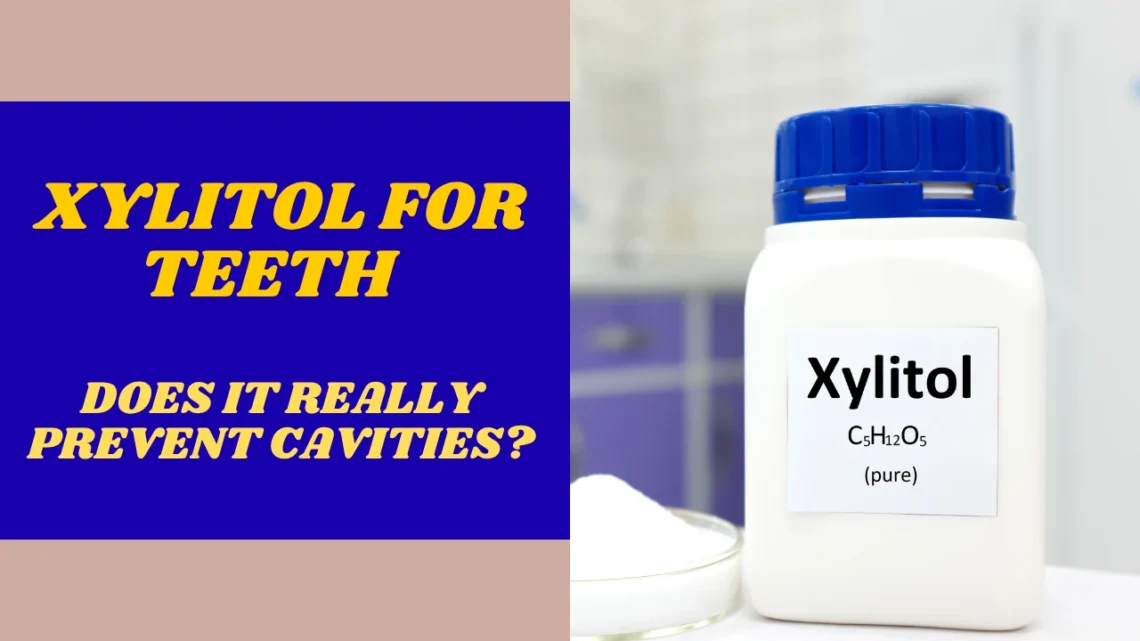
Yes, xylitol can be good for your teeth. Unlike regular sugar, xylitol does not feed the bacteria that cause cavities. It may help reduce plaque, lower the risk of tooth decay, and support better oral health. That’s why it is often found in sugar-free gum, mints, and dental products. However, xylitol works best when combined with regular brushing, flossing, and routine dental care.
You have probably seen xylitol listed on your chewing gum packet. Maybe on a toothpaste tube. Maybe someone told you it is good for your teeth and you just nodded and moved on.
But does it actually work? Or is it just another ingredient companies put on labels to make their product sound healthy?
I get this question a lot in my clinic. And the answer is genuinely interesting — because xylitol is one of the very few natural ingredients in dentistry that has real science backing it up.
Let me explain exactly what xylitol is, how it works in your mouth, what the research actually says, and how to use it correctly to get the most benefit.
What Is Xylitol?
Xylitol is a natural sugar alcohol. It is found in small amounts in many fruits and vegetables — birch trees, corn cobs, strawberries, cauliflower. Your own body even produces a small amount of xylitol daily during normal metabolism.
It looks like sugar. It tastes like sugar. It has almost the same sweetness as regular table sugar. But chemically, it is very different — and that difference is exactly what makes it interesting for your teeth.
Regular sugar (sucrose) has a six-carbon structure. Xylitol has five carbons. This one difference changes everything about how bacteria in your mouth respond to it.
Why Regular Sugar Destroys Your Teeth
To understand why xylitol helps, you first need to understand why regular sugar hurts.
Your mouth is home to hundreds of species of bacteria. Most of them are harmless or even beneficial. But one species — Streptococcus mutans — is the main villain behind tooth decay.
Here is what happens every time you eat sugar:
S. mutans feeds on the sugar. As it digests it, it produces lactic acid as a byproduct. That acid drops the pH in your mouth from a neutral 7.0 to as low as 4.0 — well below the critical threshold of 5.5 where enamel begins to dissolve.
This process happens within minutes of eating sugar. And if it happens repeatedly throughout the day — every snack, every sweet drink, every piece of candy — your enamel never gets enough time to remineralize. Slowly, the acid eats holes in your teeth. Those holes are cavities.
This is not complicated. Sugar feeds bacteria. Bacteria produce acid. Acid destroys enamel.
Xylitol breaks this chain at the very first step.
How Xylitol Actually Works Against Cavities
This is where it gets genuinely fascinating.
Streptococcus mutans cannot tell the difference between xylitol and regular sugar when it first encounters it. It picks up xylitol the same way it picks up sucrose and tries to metabolize it.
But here is the problem for the bacteria — it cannot process xylitol. The five-carbon structure gets stuck inside the bacterial cell. The bacteria cannot digest it, cannot produce energy from it, and cannot excrete it efficiently either.
The result? The bacteria essentially waste energy trying to process something useless. They become less active. They reproduce more slowly. And over time — with consistent xylitol exposure — the population of S. mutans in your mouth actually decreases significantly.
This is fundamentally different from fluoride, which strengthens enamel to resist acid. Xylitol attacks the problem at the source — it reduces the number of acid-producing bacteria in your mouth in the first place.
Beyond that, xylitol does several other helpful things:
It stimulates saliva production. Chewing xylitol gum increases saliva flow. Saliva is your mouth’s natural defense system — it contains calcium, phosphate, and antimicrobial proteins that remineralize enamel and suppress bacteria. More saliva means a more protected mouth.
It raises mouth pH. By reducing bacterial acid production, xylitol helps keep your mouth closer to neutral pH — the environment where enamel stays intact and even repairs itself.
It reduces bacterial stickiness. S. mutans normally produces sticky compounds that help it cling to tooth surfaces and form plaque. Xylitol interferes with this process, making bacteria less able to stick to enamel.
It may help remineralize early cavities. When combined with fluoride — in toothpaste for example — xylitol has been shown in some studies to enhance remineralization of early enamel lesions that have not yet become full cavities.
What Does the Research Actually Say ?
Here is where I want to be honest with you — because the research on xylitol is genuinely strong, but it has also been overhyped in some areas.
The strong evidence:
A landmark long-term study in Finland — often called the Turku Sugar Studies — first demonstrated in the 1970s that replacing dietary sugar with xylitol led to a dramatic reduction in cavity rates. Participants who used xylitol instead of sucrose had 85% fewer new cavities over a two-year period.
Multiple clinical trials since then have confirmed that regular xylitol use — particularly through chewing gum — significantly reduces S. mutans levels in saliva. Some studies show reductions of 50 to 70% in these bacteria with consistent daily use.
A particularly interesting line of research involves mothers and young children. S. mutans is not something you are born with — it is transmitted, usually from mother to child through saliva. Studies have shown that mothers who chew xylitol gum regularly transmit significantly lower amounts of cavity-causing bacteria to their infants — giving children a healthier oral microbiome from the start.
The World Health Organization, the American Dental Association, and the European Academy of Paediatric Dentistry have all acknowledged xylitol’s evidence base for cavity prevention.
Where the evidence is more mixed:
Not all xylitol products deliver the same benefit. The dose matters enormously — most clinical studies showing significant results used 6 to 10 grams of xylitol per day, spread across multiple exposures. A single stick of xylitol gum contains about 1 gram. Chewing one piece a day will not move the needle much.
Also — xylitol in toothpaste and mouthwash has less consistent evidence than xylitol delivered through gum or lozenges. This is because contact time matters. Gum keeps xylitol in contact with teeth and saliva for several minutes. Toothpaste is rinsed away quickly.
How Much Xylitol Do You Need Per Day ?
This is the question most articles skip — and it is the most important one.
The clinically effective dose is 6 to 10 grams per day, divided into at least 3 to 5 separate exposures throughout the day.
Why spread it out? Because each exposure creates a window of reduced bacterial activity and elevated pH. More frequent, smaller exposures throughout the day are more effective than one large dose.
Practical breakdown:
A standard xylitol gum piece contains 1 to 1.5 grams of xylitol. To reach 6 grams, you need 4 to 6 pieces per day — chewed after meals and snacks, not all at once.
Xylitol mints and lozenges typically contain 0.5 to 1 gram each. A lozenge after each meal gives you 3 exposures but you may need more to hit the therapeutic range.
Xylitol toothpaste contributes some xylitol but not enough on its own to reach the therapeutic dose — consider it a bonus rather than your primary source.
The Ultimate Guide to a Healthy Mouth and Oral Health
Best Ways to Use Xylitol for Maximum Benefit
After every meal — chew xylitol gum for 5 minutes. This is the single highest-impact habit. After eating, bacteria begin producing acid within minutes. Chewing xylitol gum immediately after a meal neutralizes acid, stimulates saliva, and exposes S. mutans to xylitol during its active feeding period — when it is most vulnerable.
Use xylitol mints between meals. If you cannot chew gum at work or in meetings, xylitol mints work well. Suck them slowly rather than crunching them — longer contact time means more benefit.
Choose xylitol toothpaste. Not all toothpastes contain xylitol. Check the label. Look for it listed in the first few ingredients — not buried at the bottom where the amount is negligible.
Look for 100% xylitol gum — not just “contains xylitol.” This is critical. Many popular gum brands list xylitol as an ingredient but are actually sweetened primarily with other sugar alcohols like sorbitol or maltitol. These do not have the same anti-cavity effect. The gum needs to be sweetened with xylitol as the primary or only sweetener.
Brands to look for: Spry, Epic Dental, Xylichew, and Zellies are all 100% xylitol gum brands with good evidence behind them. Check the label before buying.
Who Benefits Most From Xylitol ?
Xylitol benefits everyone — but some groups see especially significant results.
Children and teenagers. The cavity-prone years. Starting xylitol habits early — age 6 months through adolescence — can dramatically reduce lifetime cavity rates. Pediatric dentists increasingly recommend xylitol drops for infants and toddlers.
People with high cavity rates. If you seem to get cavities despite good hygiene, you likely have elevated S. mutans levels. Xylitol directly targets this bacteria more than any other population.
Pregnant women. As mentioned — regular xylitol use during and after pregnancy reduces mother-to-child transmission of cavity-causing bacteria. This is one of the most impactful uses of xylitol in all of dentistry.
People with dry mouth. Whether from medication, medical conditions, or aging — dry mouth creates a high-cavity environment. Xylitol gum stimulates saliva flow and partially compensates for reduced natural protection.
People with braces or orthodontic appliances. Brackets and wires create dozens of new hiding spots for bacteria and plaque. Cavity risk skyrockets during orthodontic treatment. Xylitol gum is safe with most fixed appliances — check with your orthodontist — and helps reduce bacterial activity around brackets.
Elderly patients. Root surfaces become exposed with age as gums recede. Root caries (cavities on the root surface) are extremely common in older adults. Xylitol toothpaste and lozenges are particularly helpful in this group.
Is Xylitol Safe ?
For humans — yes. Xylitol is classified as safe by the FDA, the European Food Safety Authority, and health agencies in dozens of countries. It has been used in food products for decades.
There is one important safety note. Xylitol is extremely toxic to dogs. Even a small amount can cause life-threatening hypoglycemia (low blood sugar) and liver failure in dogs. If you have dogs at home, keep all xylitol products — gum, mints, toothpaste, baked goods made with xylitol — completely out of reach.
For humans, very high doses of xylitol (usually 40+ grams per day) can cause digestive upset — bloating, gas, loose stools. At the therapeutic dental dose of 6 to 10 grams per day, most people experience no side effects at all. If you are new to xylitol, start with a smaller amount and build up over a week or two to let your digestive system adjust.
Does Xylitol Replace Fluoride ?
No. And this is important.
Xylitol and fluoride work through completely different mechanisms and they work better together than either does alone.
Fluoride strengthens enamel structure — it gets incorporated into the enamel crystal and makes it more resistant to acid attack. Xylitol reduces the bacteria producing that acid in the first place.
Think of it this way. Fluoride is better armor. Xylitol means fewer attacks.
Using both together gives you the best of both worlds. This is why many high-quality toothpastes now include both fluoride and xylitol — the combination is more effective than either ingredient alone.
Xylitol vs Other Sugar Alcohols
Walk into any pharmacy and you will see gum labeled with sorbitol, mannitol, erythritol, maltitol — all sugar alcohols. Are they all the same as xylitol?
No. Not even close.
Sorbitol — The most common sugar alcohol in gum. S. mutans can actually partially ferment sorbitol. It is much less effective than xylitol and produces some acid — less than sucrose, but not zero. Sorbitol gum is still better than sugar gum, but not as beneficial as xylitol gum.
Erythritol — Increasingly popular and actually quite promising. Early research suggests erythritol may be even more effective than xylitol at reducing S. mutans levels. Watch this space — it is the most interesting emerging alternative.
Maltitol — Not significantly beneficial for teeth. Bacteria can ferment it almost as easily as regular sugar.
Mannitol — Similar to sorbitol in its limited dental benefit.
If you are buying gum or mints specifically for oral health benefits — read the label. Xylitol or erythritol should be the primary sweetener listed. If sorbitol is first on the ingredient list and xylitol is sixth — that product will not give you meaningful cavity protection.
Frequently Asked Questions
How long does it take for xylitol to reduce cavity risk? Most clinical studies show measurable reductions in S. mutans levels within 4 to 6 weeks of consistent daily use at therapeutic doses. Cavity rate reductions become apparent over months to years of continued use.
Can xylitol reverse an existing cavity? No. Once a cavity has formed — meaning bacteria have created a physical hole in the enamel — xylitol cannot reverse it. However, xylitol combined with fluoride may help remineralize very early lesions (called white spot lesions) before they become full cavities.
Is xylitol gum better than no gum at all? Yes, significantly. Any sugar-free gum stimulates saliva — which is itself protective. But xylitol gum adds the direct anti-bacterial benefit on top of the saliva stimulation.
Can children use xylitol? Yes — xylitol is safe and beneficial for children. For very young children who cannot safely chew gum, xylitol drops, syrup, and toothpaste formulated for children are available. Always use age-appropriate products and amounts.
Does xylitol help with gum disease? Xylitol primarily targets S. mutans — the cavity-causing bacteria. Its effect on the bacteria responsible for gum disease (like P. gingivalis) is less well established. For gum disease specifically, oral probiotics and professional treatment are more directly targeted interventions.
Is xylitol toothpaste worth the extra cost? If it contains a meaningful amount of xylitol — yes. Look for it listed early in the ingredients. Combined with fluoride, it offers better protection than fluoride alone. But do not rely on toothpaste as your only xylitol source — the dose from brushing alone is unlikely to reach therapeutic levels.
The Bottom Line
Xylitol is not marketing hype. The science behind it is solid, the mechanism is well understood, and the clinical evidence — built over more than 50 years of research — consistently shows that regular xylitol use reduces cavity rates meaningfully.
But it only works if you use it correctly.
The right dose is 6 to 10 grams per day. The right form is 100% xylitol gum or lozenges. The right timing is after meals and snacks — spread across the day, not all at once.
It works best as part of a complete routine — alongside brushing with fluoride toothpaste, flossing daily, and regular professional cleanings. Not as a replacement for any of those habits.
If you are someone who gets cavities regularly despite decent oral hygiene — xylitol is genuinely worth adding to your routine. It directly targets the bacteria causing your problem in a way that brushing alone simply cannot.
Start with a pack of 100% xylitol gum. Chew a piece after each meal. Give it three months.
Your next dental check-up may be the best one you have had in years.