
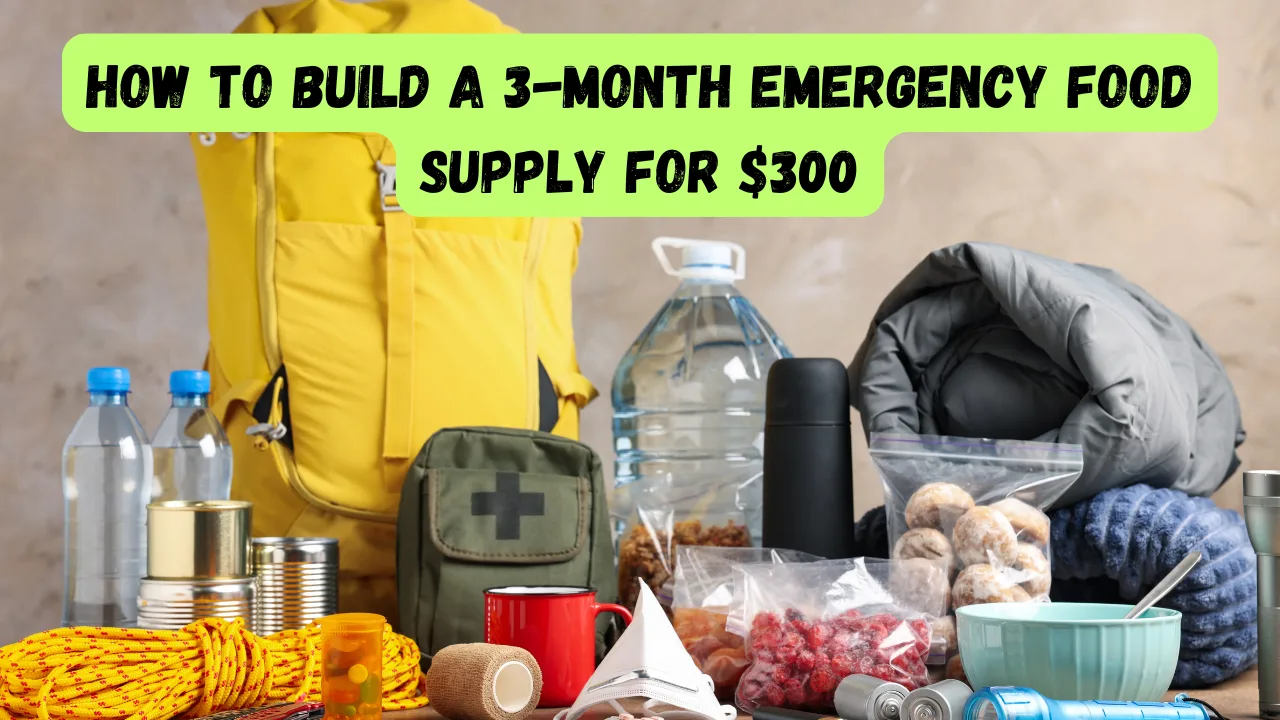
Most people think emergency food storage is expensive. It is not. With a smart plan and the right foods, you can build a full 3-month emergency food supply for just $300 — that is only $100 per month, or about $3.33 per day.
This guide gives you a step-by-step plan, a full shopping list, and storage tips to get started today — even on a tight budget.
Why You Need a 3-Month Emergency Food Supply
Emergencies happen without warning. Natural disasters, job loss, power outages, supply chain problems, or health crises can all cut off your access to fresh food at any time.
A 3-month food supply gives you:
- Security — You never need to panic-buy during a crisis
- Savings — Bulk buying is always cheaper per unit
- Independence — You are not dependent on grocery stores or food delivery
- Peace of mind — Knowing your family is fed no matter what happens
The Federal Emergency Management Agency (FEMA) and the Red Cross both recommend keeping at least a 72-hour food supply. But most experts in emergency preparedness suggest 3 months as the real safety net.
What You Need to Know Before You Start
How Many Calories Per Day?
An average adult needs about 2,000 calories per day to stay healthy. For a 3-month supply (90 days), one person needs approximately:
- 180,000 total calories
- 2,000 calories × 90 days = 180,000 calories
This guide is built for one adult. If you have a family, multiply the quantities by the number of people.
The 3 Rules of Budget Emergency Food Storage
- Buy in bulk — Larger quantities always cost less per pound
- Choose calorie-dense foods — You get more energy per dollar
- Pick foods you already eat — Do not store foods you dislike or do not know how to cook
The $300 Emergency Food Supply Shopping List
Here is a complete shopping list organized by food category. Prices are based on average US store and warehouse club prices (like Costco, Walmart, or Sam’s Club).
Category 1: Grains and Starches — Budget: $80
These are your calorie foundation. They are cheap, filling, and last for decades when stored properly.
| Item | Quantity | Approx. Cost | Calories (total) |
| White rice (long grain) | 25 lbs | $18 | ~40,000 |
| All-purpose white flour | 25 lbs | $12 | ~40,000 |
| Rolled oats | 10 lbs | $10 | ~17,000 |
| Dried pasta | 10 lbs | $12 | ~16,000 |
| Cornmeal | 5 lbs | $5 | ~8,000 |
| Hardtack crackers (or make your own) | 2 lbs | $8 | ~3,500 |
| Instant mashed potato flakes | 5 lbs | $10 | ~8,000 |
| Bread mix (or extra flour) | 5 lbs | $5 | ~8,000 |
| Category Total | ~$80 | ~140,500 |
Category 2: Proteins — Budget: $75
Protein keeps your muscles strong and your energy stable. These options are affordable and shelf-stable.
| Item | Quantity | Approx. Cost | Notes |
| Dried pinto beans | 10 lbs | $12 | High protein + fiber |
| Dried lentils | 5 lbs | $7 | Fast cooking, nutritious |
| Dried black beans | 5 lbs | $8 | Good variety |
| Canned tuna (in water) | 12 cans | $15 | Complete protein |
| Canned chicken | 6 cans | $12 | Easy to use in meals |
| Canned salmon | 4 cans | $10 | Omega-3 fats included |
| Peanut butter | 2 jars (40 oz) | $11 | High calorie, high protein |
| Category Total | ~$75 |
Category 3: Fats and Oils — Budget: $25
Fat is the most calorie-dense food group. You need fat for cooking, energy, and absorbing vitamins.
| Item | Quantity | Approx. Cost | Notes |
| Vegetable oil or canola oil | 1 gallon | $10 | Versatile cooking oil |
| Coconut oil | 54 oz jar | $10 | Very long shelf life |
| Ghee (clarified butter) | 1 lb | $5 | Lasts years at room temp |
| Category Total | ~$25 |
Category 4: Fruits and Vegetables — Budget: $45
Fresh produce will not last without refrigeration. Use canned, dried, or powdered options instead.
| Item | Quantity | Approx. Cost | Notes |
| Canned tomatoes | 12 cans | $12 | Sauce, soup base |
| Canned corn | 6 cans | $6 | Easy side dish |
| Canned green beans | 6 cans | $6 | Nutritious, simple |
| Canned mixed vegetables | 6 cans | $7 | Variety |
| Dried fruit mix (raisins, apricots) | 2 lbs | $8 | Vitamins + natural sugar |
| Tomato powder | 1 lb | $6 | Lightweight, versatile |
| Category Total | ~$45 |
Category 5: Flavor, Baking, and Extras — Budget: $40
Without flavor, you will get tired of eating the same bland foods very quickly. These items also help you cook properly.
| Item | Quantity | Approx. Cost | Notes |
| Salt (iodized) | 5 lbs | $4 | Preservation + flavor |
| White sugar | 5 lbs | $5 | Baking + energy |
| Baking soda | 2 lbs | $3 | Cooking + cleaning |
| Baking powder | 1 lb | $3 | Baking breads |
| Honey | 2 lbs | $8 | Sweetener + medicine |
| Soy sauce (or bouillon cubes) | 2 bottles | $5 | Flavor base for rice and beans |
| Mixed dried spices (cumin, chili, garlic, pepper) | Variety | $7 | Make food enjoyable |
| Apple cider vinegar | 1 quart | $5 | Preserving + cooking |
| Category Total | ~$40 |
Category 6: Drinks and Hydration — Budget: $15
Water is more important than food, but drink variety helps with morale and nutrients.
| Item | Quantity | Approx. Cost | Notes |
| Instant coffee | 1 large jar | $8 | Lasts 20+ years sealed |
| Dried tea bags | 100 bags | $5 | Comfort + antioxidants |
| Water purification tablets | 1 pack | $2 | For emergency water safety |
| Category Total | ~$15 |
Full Budget Summary
| Category | Budget |
| Grains and Starches | $80 |
| Proteins | $75 |
| Fats and Oils | $25 |
| Fruits and Vegetables | $45 |
| Flavor, Baking, and Extras | $40 |
| Drinks and Hydration | $15 |
| Total | ~$280 |
You have about $20 left for extra items, containers, or a few personal favorites. Total stays well under $300.
The Ultimate Guide to Long-Term Survival Food Storage
How to Store Your Emergency Food Supply
Buying the right food is only half the job. Storing it correctly is what makes it last.
The Best Containers to Use
- Mylar bags — Best for dry foods like rice, beans, oats, and flour. Block light and oxygen.
- Food-grade 5-gallon buckets — Put sealed Mylar bags inside for extra protection.
- Mason glass jars — Good for spices, honey, salt, sugar, and small quantities.
- Original sealed cans — Great for canned goods. Keep in a pantry or box.
Oxygen Absorbers
Always use 300cc or 2000cc oxygen absorbers inside Mylar bags before sealing. Oxygen is the main enemy of long-term food storage. Removing it can multiply your food’s shelf life by 10x.
Where to Store Everything
The ideal storage location is:
- Cool — below 70°F (21°C) if possible
- Dark — away from sunlight and UV light
- Dry — no moisture or humidity
- Stable — no big temperature swings
A basement, interior closet, or under a bed works well. Avoid garages or attics where temperatures change a lot.
Sample Meal Plan Using Your $300 Supply
Here is a simple example of how you can eat well every day using only these stored foods:
Breakfast:
- Oatmeal with honey and dried fruit
- Cup of instant coffee or tea
Lunch:
- Rice and bean bowl with canned tomatoes and spices
- Hardtack cracker with peanut butter
Dinner:
- Pasta with canned tuna and tomato sauce
- Canned vegetables on the side
Snacks:
- Peanut butter on crackers
- Dried fruit
This simple plan gives you approximately 2,000–2,200 calories per day — enough for a healthy adult.
How to Build Your Supply Step by Step
You do not need to spend $300 all at once. Build slowly if your budget is tight.
Month 1 — Start with the Foundation ($100) Buy your grains first: rice, oats, flour, and pasta. Add beans and peanut butter. These are your core survival calories.
Month 2 — Add Protein and Flavor ($100) Buy canned meats, lentils, oils, and your spice and baking kit. Now you can make real, flavorful meals.
Month 3 — Fill the Gaps ($100) Add canned vegetables, dried fruits, drinks, and any personal favorites. Buy containers and oxygen absorbers to seal everything properly.
Common Mistakes to Avoid
Mistake 1: Buying foods you never eat If you never eat lentils now, you will not want to eat them during a stressful emergency. Stick to familiar foods.
Mistake 2: Not rotating your stock Even long-lasting foods should be rotated. Use the oldest items first and replace them. This is called the FIFO method — First In, First Out.
Mistake 3: Forgetting a manual can opener This sounds funny but it is very real. Every emergency kit needs a quality manual can opener. Do not forget this.
Mistake 4: No water plan Food storage means nothing without water. Store at least 1 gallon of water per person per day, or have a water filtration system ready.
Mistake 5: Storing in the wrong location Heat destroys food faster than almost anything. Never store emergency food in a garage, car, or anywhere that gets hot in summer.
Frequently Asked Questions (FAQ)
Q: Can one person really survive 3 months on $300 of food? Yes. The foods on this list are calorie-dense and nutritionally balanced. You will not be eating gourmet meals, but you will have enough energy and nutrients to stay healthy.
Q: Do I need any special equipment? A manual can opener, airtight containers or Mylar bags, and oxygen absorbers are the most important items. Total cost is about $20–$30 extra.
Q: How often should I check and replace my stored food? Check your supply every 6–12 months. Replace any cans that are dented, rusted, or bulging. Rotate items that are approaching their best-by dates.
Q: What about vitamins? Long-term food storage can be low in certain vitamins, especially Vitamin C and Vitamin D. Consider adding a bottle of multivitamins to your supply for about $10–$15.
Q: Is this enough food for a family of four? Multiply all quantities by four and the total budget by four — approximately $1,200 for a family of four for 3 months. That is still only $400 per person.
Final Thoughts
Building a 3-month emergency food supply does not require a lot of money or special knowledge. With $300, basic containers, and a simple storage plan, any person or family can be prepared for almost any emergency.
Start today. Even buying just one extra bag of rice and one extra can of beans every week is a step in the right direction. Small steps add up quickly.
Your future self will thank you.