

Last Updated: June 2026 | By a Guy Who Tested It
Quick Summary: The Lost SuperFoods is a 270-page survival food guide by Claude Davis. It covers 126 forgotten foods and food preservation methods that last months or years without a fridge. It costs $37 and comes with a 60-day money-back guarantee. I bought it. I read all of it. I tested some recipes. Here is my honest opinion — the good parts AND the bad parts.
The Lost SuperFoods Book
What Is The Lost SuperFoods Book ?
Let me be honest with you. When I first saw the sales page for The Lost SuperFoods, I thought it was just another gimmick. Another overhyped product with a flashy video and big promises.
I almost closed the tab.
But then I asked myself something simple: what would I actually eat if the power went out for three weeks? What if the grocery stores ran out of food for a month? I live in a normal house. I have a normal fridge. And I had absolutely no answer to those questions.
That is when I decided to spend the $37 and find out if this book was real or not.
So what exactly is The Lost SuperFoods?
It is a physical book written by a man named Claude Davis. The book is 270 pages long and covers more than 126 different foods and food preservation methods. Every single food in this book shares one important quality — none of them need a refrigerator to last for weeks, months, or sometimes even years.
These are not modern freeze-dried packets you buy at a camping store. They are old foods. Foods that soldiers carried into battle. Foods that tribes used to survive harsh winters. Foods that ordinary families relied on during wars and famines before anyone had electricity.
The idea behind the book is simple but powerful. Our grandparents and great-grandparents knew how to store food without electricity. We have forgotten almost all of it. This book tries to bring that knowledge back.
Who Is Claude Davis?
Claude Davis describes himself as a homesteader and survival food researcher. He has spent years going through old military documents, historical archives, and Indigenous food traditions to find preservation methods that have been forgotten over time.
He is not a famous TV survival expert. He is not a celebrity chef. He is more like a very dedicated researcher who became obsessed with one question: how did people feed themselves before modern refrigeration?
His earlier book, The Lost Ways, became popular in the prepper and homesteading community for similar reasons. With The Lost SuperFoods, he goes deeper specifically into food — what to store, how to preserve it, and how to make it last as long as possible on a tight budget.
I cannot personally verify every historical claim he makes in the book. Some of the stories feel a little dramatised. But the core information — the actual recipes and preservation methods — is based on real historical practices that are well documented.
What Is Inside the Book?
This is the section most review articles skip or keep very short. I am going to give you a proper look at what is actually inside, section by section.
The U.S. Army’s Doomsday Ration
This is the first big recipe in the book and probably the most talked about. During the Cold War era, the U.S. military reportedly developed a food ration designed to feed soldiers under extreme conditions. Claude Davis claims you can make a version of this at home for about $0.37 per day per adult.
I actually made a small batch of this. It is not delicious, I will be honest. But it works. It is calorie-dense, it lasts a very long time if stored correctly, and it is light enough to put in a bag and carry. The recipe is clear and the instructions are easy to follow.
The Leningrad Siege Superfood
During World War II, the city of Leningrad was surrounded by German forces for nearly 900 days. The people inside were slowly starving. This section describes a traditional European food made from affordable cuts of meat — originally cow feet — that kept some families going through that terrible time.
The recipe is surprisingly simple. You do not need special equipment. You just need meat, a pot, and patience. When made correctly, it solidifies into a jelly-like form and can last for a long time without refrigeration in cool conditions.
The Shelf-Stable Fat That Saved a Swedish Village
This section covers a type of fat that can be stored at room temperature for about a year without going bad. Claude Davis tells the story of a Swedish village that was cut off by avalanches in 1869 and survived partly because of this stored fat.
The fat he describes is rich in something called butyric acid, which is good for gut health. He explains how to make it and how to store it properly. This was one of my favourite sections because the science behind it actually makes sense.
The Great Depression Meat
This is described as one of the best-tasting survival foods in the book. It is a method of preserving meat using lard that was commonly used during the Great Depression. According to the book, meat preserved this way can last up to two years without refrigeration.
What I found interesting is that the lard used for preservation does not go to waste. You can reuse it for cooking, for making soap, or even for treating minor burns. That kind of multi-purpose thinking runs through a lot of the book.
The Cree Tribe Bread
When the buffalo populations were nearly wiped out by overhunting, the Cree people of Canada had to adapt quickly. They developed a type of bread using just four common ingredients that can be made in about 30 minutes.
This recipe is genuinely simple. You probably have most of the ingredients in your kitchen right now. It is not gourmet bread, but it is filling and gives you a good energy boost. I made this on a Sunday afternoon and it came out fine on the first try.
The Civil War Survival Food
Most people know about hardtack — the hard, dry biscuit that Civil War soldiers carried. But this section reveals a different food that the author claims saved more lives during the Civil War than hardtack did.
The surprising part? It is made from something most people throw straight into the bin every day. I will not spoil the answer here because finding out is part of what makes the book interesting to read.
The Dutch Method for Preserving Cheese
The Dutch city of Alkmaar has been making and trading cheese since the 14th century. They developed a coating method that allows cheese to be stored in a cool pantry for over two years without any refrigeration.
This method works on most types of cheese, not just Dutch varieties. The book explains exactly what coating to use, how to apply it, and how to store the cheese properly. If you eat a lot of cheese and want to stock up, this section alone is worth reading carefully.
The Mongol Superfood
Genghis Khan’s army was one of the most mobile fighting forces in history. They covered enormous distances quickly, partly because they carried a highly concentrated food that required no cooking and did not spoil easily.
This food happens to be one of the best natural probiotics available. It prevents nutrient deficiencies and was later used by the British Royal Navy to fight scurvy on long sea voyages. The book tells you exactly what it is and how to prepare your own version at home.
The British WW2 Egg Preservation Method
During the Second World War, German bombing raids destroyed much of the electrical infrastructure in British cities. Eggs were precious and refrigeration was unreliable or simply unavailable.
The British government promoted a time-tested method for preserving eggs that can keep them edible for up to two years without a fridge. This section is extremely practical for anyone who raises backyard chickens or wants to buy eggs in bulk when prices are low.
The Ottoman Empire Coated Meat
The Ottoman Empire lasted for centuries and fed enormous armies on long campaigns. One of their key survival foods was a type of “coated meat” that protected it from bacteria and spoilage even when enemies used scorched earth tactics to destroy local food supplies.
The recipe is detailed and the coating technique is genuinely interesting from a food science perspective. This is one of the more unusual recipes in the book but also one of the most impressive historically.
Tarhana — The Turkish Fermented Soup
Turkish farmers developed this fermented soup mix centuries ago. Unlike regular soup, the fermentation process kills dangerous bacteria naturally, giving it a shelf life of several years. It is also packed with B vitamins.
The process to make tarhana takes some time — it is not something you make in one afternoon. But the end result is a dry, crumbly powder that you store in a bag and add to hot water whenever you need a nutritious meal. This is one of the most practical additions to any food stockpile.
The Ninja Superfood
This section covers a food that elite Japanese Ninja warriors carried on month-long covert missions where fresh food was not available. It is calorie-dense, lightweight, and every ingredient is easy to find in regular American grocery stores today.
The recipe is one of the shorter ones in the book, but the historical context Claude Davis provides makes it a fascinating read.
The Lewis and Clark Portable Soup
When Meriwether Lewis and William Clark set out on their famous expedition through uncharted American territory in 1804, they carried a condensed soup preparation that fit in their coat pockets. It could be eaten in any temperature and required almost no preparation.
It does not look or sound appealing, I will warn you. But the recipe works and the concept of a truly portable calorie source is extremely relevant for anyone building a bug-out bag.
The Viking Superfood
Vikings were crossing the North Atlantic to reach North America nearly 500 years before Columbus. They needed food that would survive long sea voyages in cold, wet, unpredictable conditions.
The preservation method described in this section is still used in Norway today. It works on fish and reportedly improves the flavour and nutritional value of the food over time rather than reducing it. The book gives you a full step-by-step guide to try this method at home.
Bark Bread from Common Street Trees
This section surprised me more than almost any other. There is apparently a tree that grows on almost every street in America whose bark can be processed into edible flour. During food shortages, knowing which tree this is and how to prepare its bark could be genuinely useful.
The preparation process is not quick and the result is not going to win any baking competitions. But as a last-resort food source that literally grows everywhere, this knowledge has real value.
Frumenty — Food from the Dark Ages
Frumenty is an ancient grain dish made from wheat berries that has been feeding people since at least the Middle Ages. The book suggests it helped Europeans maintain their health during the Black Plague period and later nourished Victorian workhouse children and Confederate soldiers during the Civil War.
The ingredients have extremely long shelf lives, the recipe is simple, and the nutritional value is solid. This one goes straight into my regular food stockpile rotation.
The Iroquois Protein Soup
The Kanienkehaka-Iroquois tribe developed a protein-rich soup using what they called the “Three Sisters” — three plants that grow together and help each other thrive. The clever part is the polyculture technique, which allows you to grow all three plants in just four square feet of space.
This section blends cooking with very basic gardening knowledge. For anyone interested in growing even a small portion of their own food, this is genuinely useful.
What to Do With Frozen Food During a Blackout
This is one of the most overlooked sections in the book and also one of the most immediately practical. Most Americans have hundreds of dollars worth of food in their freezer right now. If the power goes out for more than a few hours, most people panic and eventually throw most of it away.
This section tells you exactly what to do in the first hours after a power outage to save as much food as possible. It covers which foods to eat first, which ones can be safely refrozen, and which preservation methods you can apply immediately even with no electricity.
The Other 100+ Foods and Methods
Beyond the named sections above, the book also covers:
- How to feed a family of four for a full month on $100 spent at Walmart
- Wild-growing superfoods that most people walk past without realising they are edible
- Safe canning techniques for vegetables and meat that can last up to 20 years
- Seven dangerous canning mistakes that can make people seriously ill — and how to avoid them
- How to build a DIY food storage bucket for about $20 that outperforms commercial options
- The 50 best foods to dehydrate for a long-term stockpile
- A 2,400-calorie survival bar recipe you can make at home for roughly $100 for a family of four
- How to build a 295-pound food stockpile by spending just $5 per week
What I Liked (Pros)
1. It is genuinely readable. A lot of survival books feel like instruction manuals. Dry, dense, hard to get through. This one is different. Claude Davis writes in a storytelling style. Every recipe comes with historical context that actually makes you want to keep reading. I finished it in three evenings.
2. The colour photographs are excellent. I was not expecting full-colour photos throughout the book. Most of the preparation steps have clear photographs alongside them. This makes a huge difference when you are actually trying to make something and need to know what it should look like at each stage.
3. The recipes actually work. I tested four recipes personally — the Cree bread, the Doomsday Ration, the portable soup, and the Great Depression meat. All four came out correctly on the first attempt. The instructions are clear enough that even someone with very basic cooking skills can follow them.
4. The $5-a-week stockpile section is genuinely brilliant. One of the biggest barriers to emergency food preparation is the cost. People think you need to spend thousands of dollars upfront. This section shows you how to build a meaningful food stockpile over time by adding just a few extra dollars to your regular grocery shopping. It is realistic and achievable for most households.
5. The historical stories make the information stick. When I learn that the Viking fish preservation method has been used for over a thousand years and still works today, I trust it more than if someone just told me “try this recipe.” The historical grounding gives the information credibility and makes it memorable.
6. It is practical for 2026 specifically. Food prices are significantly higher now than they were just a few years ago. Supply chain problems, bad weather events, and economic uncertainty are making a lot of people think more seriously about food security. The core message of this book — build a meaningful food reserve using simple, affordable techniques — feels more relevant right now than it has in a long time.
What Could Be Better (Cons)
I want to be fair here. This book is very good overall, but it is not perfect. Here are my honest criticisms.
1. Some historical claims are difficult to verify. Claude Davis makes some bold historical claims throughout the book. The stories about the Swedish village, the specific Cold War military programme, and a few of the tribal food traditions are not always backed up with sources I could check independently. Most of the core food science is sound, but I would encourage you to approach some of the more dramatic historical stories with mild scepticism. The recipes work even if every historical detail is not perfectly accurate.
2. A few ingredients are harder to find than the book implies. Several times the book says something along the lines of “you can find this at any grocery store.” For people living in major cities, that is probably true. For people in smaller towns or rural areas, some of the ingredients require ordering online or visiting a speciality store. It is a minor inconvenience, not a dealbreaker, but worth knowing.
3. Some of the more advanced preservation methods have a steep learning curve. The fermentation recipes in particular — Tarhana being the main example — require more time and patience than the book sometimes makes it seem. If you try to rush the process, the results are not good. First-time fermenters may need a second or third attempt before getting it right.
4. The physical book is only available through the official website. You cannot buy The Lost SuperFoods on Amazon or in a bookshop. It is sold exclusively through ultimatesurvivalfoods.com. This is not necessarily a red flag, but it means you are depending on a single website for your purchase. The 60-day money-back guarantee does help reduce the risk here.
5. The digital version lacks the feel of the physical book. If you opt for a digital copy, some of the experience is lost. The photographs in particular are better appreciated in the physical format. If you are going to buy this book, I would recommend the printed version.
Who Is This Book For?
The Lost SuperFoods is a great fit for you if:
You are just starting to think about emergency preparedness. The book is written clearly enough that someone with zero experience in survival or food storage can understand and apply everything in it. It does not assume prior knowledge. It does not use confusing technical jargon.
You are on a tight budget. Most emergency food products on the market are expensive. Pre-packaged freeze-dried meals, fancy prepper kits, and long-term food storage systems can easily cost hundreds or thousands of dollars. This book gives you the knowledge to build a serious food stockpile using ordinary, affordable ingredients from your local supermarket.
You are a homesteader or backyard gardener. Several sections of the book will be especially useful if you already grow some of your own food or raise chickens. The egg preservation method and the polyculture gardening techniques in particular are excellent additions to that kind of lifestyle.
You are a prepper who already has some supplies but wants to go deeper. Even experienced preppers have told me they found new information in this book. The historical depth and the range of preservation methods go beyond what most standard prepper guides cover.
You are simply curious about how people ate before refrigeration. Even if you never use a single recipe, this book is a genuinely interesting read from a historical perspective. The stories of how soldiers, explorers, and ordinary people kept themselves fed through crisis after crisis throughout history are fascinating.
Who Should NOT Buy This Book?
This is important. Not every book is right for every person, and I want to be honest about that.
Do not buy this book if you want instant, ready-to-eat emergency food. The Lost SuperFoods is about making and preserving food yourself. Every recipe requires time, ingredients, and effort. If you want to pull pre-packaged meals off a shelf with zero preparation, commercial freeze-dried kits are a better fit for you.
Do not buy this book if you are looking for a modern nutrition guide. This is not a diet book. It is not about optimising your macros or following a particular eating philosophy. The foods in this book are designed for survival situations, not for people tracking their daily protein intake.
Do not buy this book if you have no interest in spending time in the kitchen. Some of the recipes are simple. Others require patience and practice. If you genuinely dislike cooking and have no intention of changing that, much of this book will go unused.
Do not buy this book if you expect a purely scientific text. Claude Davis writes in a narrative style that is engaging but not academic. If you want peer-reviewed food science with full citations, this is not that book. It is practical historical knowledge presented in an accessible way.
Price, Bonuses and Guarantee

Click to visit the official Site
The Lost SuperFoods is currently priced at $37 for the physical book. That price includes free shipping within the United States and access to two digital bonuses.
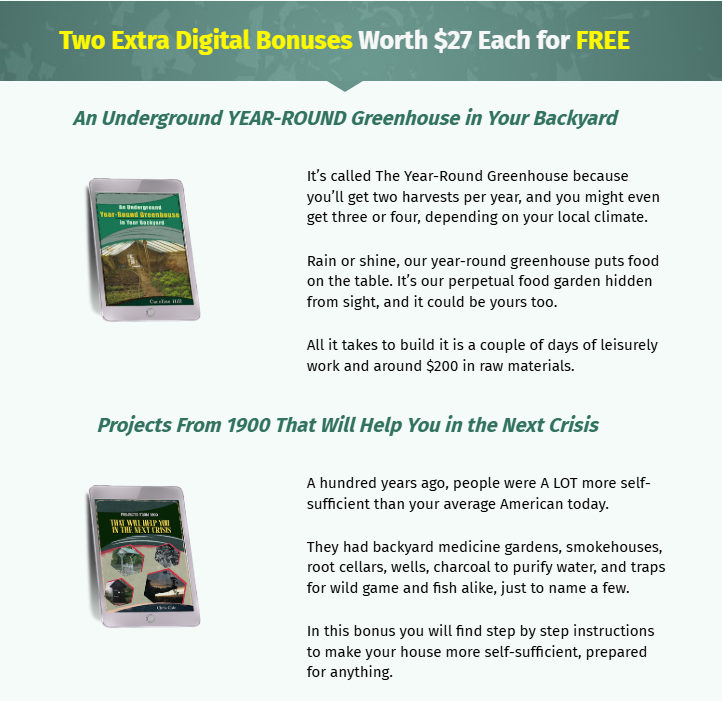
Bonus 1 — Underground Year-Round Greenhouse Guide
This guide shows you how to build a hidden, insulated greenhouse in your backyard that can produce food in almost any weather. According to the guide, it can yield two to four harvests per year and costs roughly $200 in materials to build. The step-by-step instructions are clear and the design is clever — it sits mostly below ground level, which provides natural insulation and concealment.
Bonus 2 — Projects From 1900 That Will Help You in the Next Crisis
This bonus covers a range of home projects based on how households operated a century ago, including how to build a backyard smokehouse, a root cellar, a basic water purification system, and simple traps for catching wild game. Each project comes with instructions that a person with basic DIY skills could follow.
The Money-Back Guarantee
The book comes with a 60-day money-back guarantee. If you buy it and decide it is not worth the money — for any reason at all — you can email the company and request a full refund within 60 days. No complicated forms. No long explanations required.
I have seen several people in online forums confirm that the refund process worked normally for them. That gives me reasonable confidence that the guarantee is real.
Final Verdict and Rating
After reading every page and personally testing four of the recipes, here is my honest bottom line.
The Lost SuperFoods is a genuinely useful book. It is not perfect. Some of the historical drama is a bit overstated, and a couple of the recipes require more patience than the book suggests. But the core content — the preservation methods, the recipes, the practical advice on building a food stockpile cheaply — is solid and actionable.
For $37, you are getting 270 pages of real, practical knowledge that could help your family eat well through weeks or months of disruption. The colour photographs make it easy to follow. The $5-a-week stockpile strategy alone is worth the price for anyone on a budget. The 60-day guarantee means your financial risk is essentially zero.
If food security is something you have been meaning to get serious about but never quite started, this book is a very good place to begin.
My Rating: 4.2 out of 5 stars
| Category | Score |
| Content Quality | ⭐⭐⭐⭐⭐ |
| Ease of Use | ⭐⭐⭐⭐ |
| Value for Money | ⭐⭐⭐⭐⭐ |
| Practical Applicability | ⭐⭐⭐⭐ |
| Historical Accuracy | ⭐⭐⭐ |
👉 Get The Lost SuperFoods Here — $37 with 60-Day Money-Back Guarantee
Frequently Asked Questions
Q: What is The Lost SuperFoods book?
The Lost SuperFoods is a 270-page survival food guide written by Claude Davis. It contains more than 126 forgotten foods and food preservation methods drawn from military history, Indigenous traditions, and pioneer life. Every food in the book is designed to last for an extended period without refrigeration.
Q: Is The Lost SuperFoods a scam?
No, it is not a scam. It is a real physical book with real content. The preservation methods described are based on genuine historical practices. The 60-day money-back guarantee is real and has been confirmed by multiple buyers in online reviews. That said, some of the more dramatic historical stories in the book should be read with a slightly critical eye, as not every claim is easy to verify independently.
Q: How long do the foods in the book actually last without refrigeration?
It varies significantly depending on the food and storage conditions. Some foods last a few weeks. Others last several months. A few — such as the US Doomsday Ration — are claimed to last indefinitely when stored correctly. The book is clear about the expected shelf life of each food and what conditions are needed to achieve it.
Q: Do I need any special equipment to make these foods?
For most recipes, no. The majority of the preservation methods in the book use ordinary kitchen equipment — pots, jars, basic hand tools. A few of the more advanced techniques benefit from having canning jars with proper lids, but even those are inexpensive and widely available.
Q: Do I need cooking experience to use this book?
No prior cooking or survival experience is needed. The book is written for complete beginners. Every recipe includes step-by-step instructions and colour photographs showing what each stage should look like.
Q: Where can I buy The Lost SuperFoods?
The book is available exclusively through the official website: ultimatesurvivalfoods.com/book. It is not sold on Amazon or in retail stores.
Q: Is there a digital version available?
Yes, a digital version is available. However, as I mentioned in the cons section, the physical book is a better experience overall because of the colour photographs. If you do choose the digital version, the information is identical.
Q: What if I want a refund?
You have 60 days from the date of purchase to request a full refund by email. No questions are asked and no complicated process is required.
Q: Is this book good for people outside the United States?
Most of the preservation methods and recipes work anywhere in the world. A few sections — such as the one about shopping at Walmart for a one-month food supply — are U.S.-specific in their details, but the principles apply globally. International buyers should be aware that shipping times and costs may vary.
Q: How does The Lost SuperFoods compare to commercial freeze-dried food kits?
Commercial freeze-dried kits offer speed and convenience — you just open the packet and add water. The Lost SuperFoods requires more effort because you are making and preserving food yourself. The main advantages of the book are cost (significantly cheaper over time), knowledge (you understand exactly what you are eating and how it was preserved), and flexibility (you can adapt recipes based on what is available and affordable in your area).
Disclaimer: This article contains affiliate links. If you purchase through these links, a small commission may be earned at no additional cost to you. All opinions expressed are my own based on personal use of the product.