For the first two years I had an HSA, I did nothing with it. Money went in, money came out for a dentist bill or a prescription, and that was it. I treated it like a second checking account. Looking back, that was a mistake, and I think a lot of people make the same one without even knowing it.
Here is the thing nobody told me at the start. An HSA is not just a place to park money for doctor visits. It is one of the best investment accounts you can have, if you actually invest the money inside it instead of letting it sit in cash. In this article, I will walk you through how this works, what to invest in, and some real scenarios so you can see how the numbers actually play out.
Quick Answer
- Money sitting in HSA cash earns almost nothing. Money invested in low-cost index funds can grow a lot over time, tax-free.
- For most people with a long time horizon, a simple S&P 500 or total stock market index fund is the easiest place to start.
- If you don’t want to pick funds yourself, a target-date fund does the work for you.
- Keep one to two times your deductible in cash for near-term bills. Invest the rest.
- 2026 contribution limits are $4,400 for individuals and $8,750 for families, plus $1,000 more if you’re 55 or older.
Why Most People Leave Their HSA Money Sitting in Cash
I get why this happens. An HSA feels like a medical account, not an investment account, so most people never think to check if there is an “invest” button hiding somewhere in their app. I almost missed it myself.
But here is what makes an HSA different from a regular savings account, or even a regular brokerage account. It gives you three tax breaks at once:
- Money you put in lowers your taxable income for the year.
- Money inside the account grows completely tax-free, no matter how big it gets.
- Money you take out for medical expenses comes out tax-free too.
No other account does all three of those things at the same time. Not a 401(k). Not even a Roth IRA, since a Roth only gives you two of the three. That is why leaving the money sitting in cash, earning almost nothing, feels like such a waste once you understand what is possible.
What You Can Actually Invest In
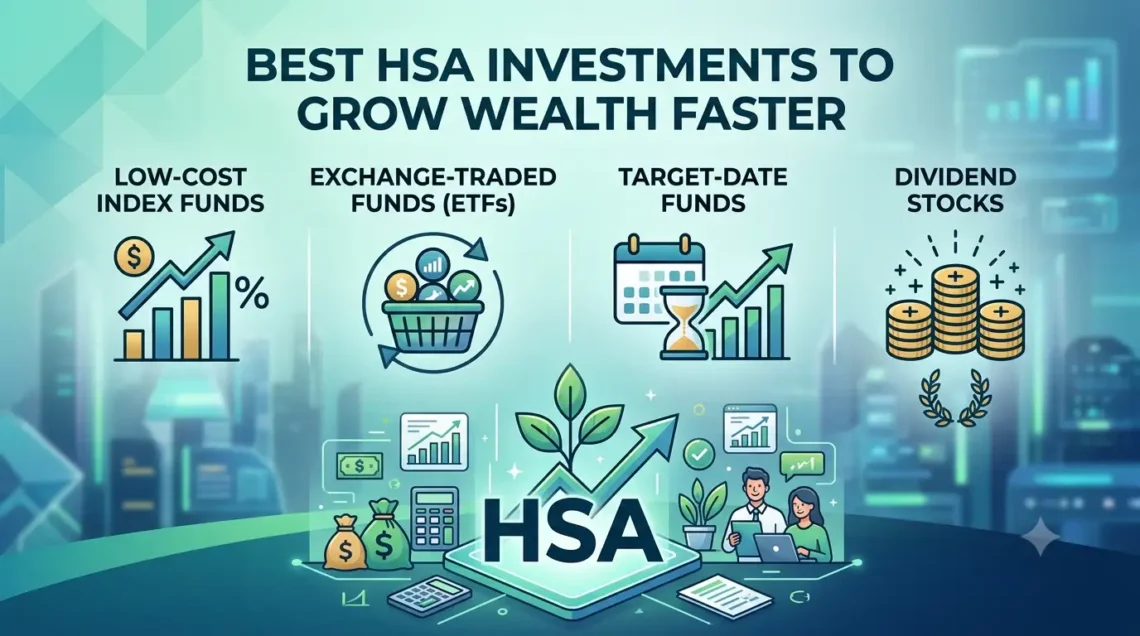
Once you click that “invest” tab, most providers show you a list of mutual funds, ETFs, and sometimes individual stocks. It can look overwhelming the first time. Here is how I think about the main categories.
Index Funds (My Personal Favorite)
These funds just track the overall stock market, or a big chunk of it, like the S&P 500. They are cheap, simple, and historically have grown well over long periods. A fund like FXAIX, which tracks the S&P 500, charges a tiny fee, often less than 0.05% a year. You are not trying to beat the market here. You are just trying to grow along with it for decades.
Target-Date Funds
These are built for people who do not want to think about rebalancing every year. You pick a fund labeled with a year close to when you think you’ll need the money, say 2045 or 2050, and the fund automatically shifts from mostly stocks to a more balanced mix as that year gets closer. I recommend this option to anyone who tells me they don’t want to “manage” anything.
Bond and Balanced Funds
These are more conservative. They don’t grow as fast, but they don’t swing around as much either. These make more sense if you’re closer to actually needing the money, or if market ups and downs make you nervous.
Managed or Advisor-Picked Portfolios
Some providers, like HSA Bank, let you answer a short questionnaire and have a registered advisor pick or manage funds for you. This costs a small extra fee, but it removes all the guesswork if you really don’t want to choose anything yourself.
How Much Should You Keep in Cash?
This is the part people ask me about most. There is no perfect number, but a common rule I follow myself is keeping one to two times my annual deductible sitting in cash. That way, if something unexpected happens, like a broken arm or a surprise trip to urgent care, I am not forced to sell investments at a bad time just to cover the bill.
If you’re young and healthy, and you can comfortably pay smaller bills straight from your checking account, you can keep less in cash and invest more. If you have ongoing health issues or a family with kids who seem to find new ways to need a doctor every few months, lean toward keeping more in cash.
Best Budgeting Apps for Single-Income Households With Kids
Real Scenarios
The Young Engineer Who Invests Aggressively
Carlos is 27 and barely visits the doctor outside his yearly checkup. He keeps about $500 in cash in his HSA and invests the rest, almost entirely in an S&P 500 index fund. His logic is simple: he has decades before he’ll likely need this money, so he wants it growing as much as possible in the meantime. If a medical bill comes up, he pays it from his checking account and saves the receipt, planning to reimburse himself from the HSA years down the road, once the invested amount has grown.
The Parent Balancing Growth and Safety
Patricia is 44 with two kids who seem to need a doctor visit every other month. She keeps a bigger cash cushion, close to her full deductible, and invests the rest in a target-date fund set for 2046, roughly when she expects to slow down working. She likes that she does not have to think about rebalancing. The fund handles the shift from stocks to bonds on its own as the years go by.
The Retiree-to-Be Playing It Safer
Frank is 58 and plans to retire in about seven years. He has shifted his HSA to a more balanced mix, somewhere around 50% stocks and 50% bonds, because he does not want a bad market year right before retirement to wreck a big chunk of his healthcare savings. He’s not trying to maximize growth anymore. He’s trying to protect what he’s already built.
A Real Example of How the Numbers Add Up
I ran the actual math on this, because round numbers and vague promises don’t mean much without seeing it play out.
Say someone contributes the full 2026 individual limit of $4,400 every year, invested in something like a low-cost index fund earning an average 7% a year, which is a commonly used long-term estimate for stock-heavy investments:
- After 10 years: around $60,800 (they put in $44,000)
- After 20 years: around $180,400 (they put in $88,000)
- After 30 years: around $415,600 (they put in $132,000)
Now picture someone who can’t max it out and instead puts away $300 a month, about $3,600 a year, for 25 years at that same 7% average return. That comes out to roughly $227,700, on $90,000 contributed.
In both cases, growth eventually does more work than the contributions themselves. That is the part a regular savings account, sitting at 1% interest, simply cannot match.
A Trick Most People Don’t Know About
You do not have to spend HSA money the same year a medical bill shows up. You can pay a bill out of pocket today, keep the receipt somewhere safe, and reimburse yourself from the HSA any time later, even decades later, as long as the bill happened after you opened the account. Some people use this on purpose. They pay smaller bills from their regular bank account now, let their HSA investments keep growing untouched, and cash in old receipts much later, pulling out money that has had years to compound in the meantime.
Common Mistakes I See People Make
The biggest one, by far, is just never investing at all. People open an HSA, contribute every year, and never notice the invest button sitting right there. The second mistake is going too conservative too early, putting everything in cash or bonds in your 20s or 30s when you have decades to ride out the ups and downs of the market. The third mistake is forgetting to keep enough cash on hand, then having to sell investments at a bad time to cover a surprise bill.
Frequently Asked Questions
What is the best investment for an HSA?
For most people with a long time horizon, a low-cost S&P 500 or total stock market index fund offers a strong mix of low fees and solid long-term growth. If you’d rather not pick individual funds, a target-date fund is a simple alternative that adjusts on its own over time.
How much of my HSA should I keep in cash?
A common guideline is one to two times your annual deductible. The right number depends on your health, your other savings, and how comfortable you are paying smaller bills out of pocket instead of from the HSA.
Can my HSA investments lose money?
Yes. Once the money is invested in funds or stocks, the balance can go up or down with the market, just like any other investment account. That is exactly why people keep a cash cushion for near-term expenses.
Do all HSA providers let me invest?
Most do, but many require a minimum cash balance first, often somewhere between $1,000 and $2,000, before you can start investing anything above that. A few providers have no minimum at all.
Is it smart to use my HSA as a retirement account?
Many people do exactly this. Since unused funds roll over every year with no expiration, some people invest their HSA aggressively and treat it as an extra retirement account, planning to use it for medical costs later in life, when those costs are often higher anyway.
Final Thoughts
Letting your HSA sit in cash for years, the way I did at first, is one of those quiet money mistakes that doesn’t feel urgent until you actually run the numbers. Once you keep a reasonable cash cushion for near-term bills, investing the rest in something simple, like an index fund or a target-date fund, lets that triple tax advantage actually do something for you. It does not need to be complicated. Pick something simple, automate it if you can, and check on it once a year.