
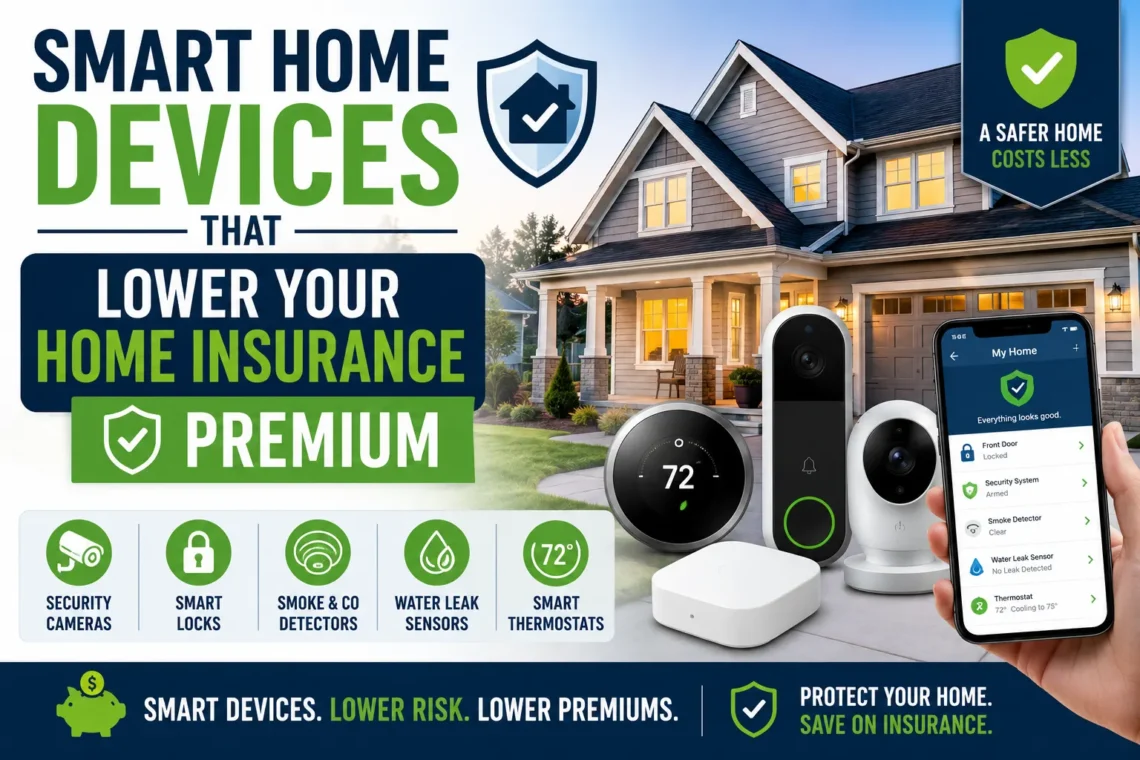
Last year my neighbor Tom got a water leak under his kitchen sink. He was at work. Nobody home. By the time he came back, the cabinet was ruined and the floor was warped. His insurance claim was almost $9,000.
I have a $45 water sensor under my sink. It is connected to my phone. If it gets wet, my phone makes a loud sound right away. That is the whole difference between Tom’s story and mine.
This is what I want to talk about today. Not just “smart home is cool.” I want to show you which devices actually lower your insurance bill, how much you really save, and which ones are mostly hype. I will use real numbers from insurance companies, not guesses.
Quick Answer
Most insurance companies give you 2% to 20% off your home insurance for smart devices, but the average is closer to 5% to 10%. The biggest discounts come from monitored security systems and water leak sensors, not smart fridges or smart light bulbs. A $108 to $280 yearly savings is normal. It will not pay for the device by itself in year one, but it adds up, and it protects you from a much bigger loss.
Now let me explain this, not reading you a brochure.
Why Do Insurance Companies Even Care About This?
Here is the simple way to think about it. Your insurance company is scared of two things: you having a disaster, and you filing a claim because of that disaster.
A smart device does not stop bad things from happening 100% of the time. But it catches problems early, before they turn into a $9,000 cabinet like Tom’s. Less damage means a smaller claim, or no claim at all. The insurance company is happy, so they give you a discount as a “thank you” for lowering their risk.
That is really it. No magic. They are not doing you a favor out of kindness. They are protecting their own money, and you get a small reward for helping them.
The Devices That Actually Move the Needle
I am going to be honest with you. Not every smart gadget gets you a discount. A smart refrigerator looks cool but your insurance company does not care about it at all, because it does not stop fires, floods, or break-ins. Here are the ones that do matter.
1. Water Leak Sensors (My Personal Favorite)
I mentioned my $45 sensor already. Let me tell you why this is the device I recommend to literally everyone first.
Water damage is one of the most common and most expensive home insurance claims that exist. Industry data shows about 1 out of every 60 homes files a water or freezing damage claim each year, and the average cost of that claim is close to $14,000.
That number shocked me the first time I saw it. $14,000 average. Not the worst case. The average.
A simple water sensor costs $25 to $60. You put it on the floor near your washing machine, water heater, or under sinks. The moment it touches water, it sends an alert to your phone. Some advanced systems, like the kind USAA partners with, can even shut off your main water valve automatically if a big leak happens.
Real example: USAA requires customers to connect at least two water leak detectors and share the data with them to start earning the discount. That tells you something important: insurers trust this device enough to base real savings on it.
Practical scenario: Say you go on a one-week vacation. A pipe behind your washing machine starts leaking on day two. Without a sensor, you come home to a flooded laundry room and a moldy wall. With a sensor, your phone buzzes on day two, you call a neighbor or a plumber, and the damage is one wet towel instead of a renovation project.
2. Monitored Security Systems
This is where the bigger discounts live.
A basic alarm that just makes noise is okay, but insurance companies reward “monitored” systems much more. Monitored means if the alarm goes off, a real monitoring company gets notified and calls the police or fire department, even if you are not home and don’t see the alert yourself.
According to industry research, a fully monitored alarm system with entry sensors on every exterior door can qualify you for a 15% to 20% discount in some cases. On a $1,500 yearly policy, a 15% discount saves you $225 a year.
Real example: Chubb, a well-known insurer, offers up to 35% off the price of certain security systems themselves, on top of separate policy discounts for having one installed.
Practical scenario: Think about a typical break-in. It usually happens during the day when houses are empty. A monitored system with door sensors and a camera does two jobs at once: it often scares off the burglar because the alarm and camera are visible, and if they still try, the monitoring company is already calling for help before you even know something is wrong.
3. Smart Smoke and Carbon Monoxide Detectors
Fire is the other disaster insurers really worry about, and for good reason. A house fire claim is usually huge, and worse, it is dangerous to people, not just property.
A smart smoke detector, like a Nest Protect or First Alert Onelink, sends an alert straight to your phone the second it senses smoke, even when you’re not home. Some models can even talk to your HVAC system and shut it down so smoke does not spread through the air ducts to other rooms.
Practical scenario: You’re cooking, you step outside for two minutes to grab something from your car, and a pan catches fire. A regular smoke detector just beeps loudly in an empty kitchen. A smart one sends you a push notification immediately, so even those two minutes don’t turn into ten.
4. Smart Thermostats (For a Very Specific Reason)
I want to be honest here, because this one surprises people. A smart thermostat doesn’t get you a discount because it’s “smart” or saves energy. It gets you a discount because of frozen pipes.
If you have a vacation home, a rental property, or you travel a lot in winter, a frozen pipe can burst while nobody is there to notice the heat went off. A smart thermostat lets you check the temperature remotely and get alerted if it drops too low, so you (or someone you trust) can act before a pipe bursts.
If you live in a warm climate and never leave your house in winter, honestly, this device probably won’t move your insurance discount much. Context matters here.
5. Smart Locks and Video Doorbells
These help a little, mostly as part of a “smart security bundle” rather than on their own. A video doorbell lets you see who’s at your door from anywhere, which helps with package theft and break-in attempts. Some insurers count this toward a broader smart home discount, but by itself, the savings are small, usually inside that 1% to 3% range.
How Much Money Are We Actually Talking About ?
Let me put real numbers in front of you instead of vague promises.
| Device Type | Typical Discount | Example Yearly Savings* |
|---|---|---|
| Monitored security system (full setup) | 15% to 20% | $225 to $300 |
| Basic smart security/camera | 5% | $108 |
| Water leak sensors | 2% to 10% | $30 to $150 |
| Hippo smart home monitoring bundle | varies | $64 to $91 average |
| Single smart device (thermostat, lock, doorbell) | 1% to 3% | $20 to $65 |
*Based on an average annual home insurance policy. Your real savings depend on your insurer, your state, and your specific policy.
One company, Hippo, actually gives customers a free smart home monitoring system as part of the policy itself, and reports their customers save an average of $64 to $91 a year just from that.
“So Is It Actually Worth Buying These Smart Home Devices?”
This is the question that matters more than the discount percentage. Let me answer it straight.
If you are buying smart devices only for the insurance discount, the math is not amazing. A $300 to $400 full security setup with a 15% discount on a $1,500 policy pays itself back in under 2 years, which is decent, but a single $45 water sensor at a 2% discount might take many years to “pay back” just from the discount alone.
But here is the real point I want you to take from this article: the insurance discount is the bonus, not the main prize. The main prize is that these devices stop disasters before they get expensive. Tom’s $9,000 cabinet didn’t need an insurance discount. It needed a $45 sensor that would have warned him three days earlier.
Think of it like a seatbelt. You don’t wear a seatbelt because your car insurance gives you a tiny discount for it (some do!). You wear it because it actually protects you when something bad happens. The discount is just a nice extra.
A Simple Game Plan If You Want to Start
You don’t need to smart-ify your whole house this weekend. Here’s the order I’d personally go in, based on what actually matters to insurers and to your safety:
- Start with one or two water leak sensors. Cheap, easy, and water damage is the most common claim there is.
- Add a smart smoke and CO detector if your current one is old or basic.
- Call your insurance agent before you buy anything else. Ask them directly: “What smart home discounts do you offer, and what exact devices or monitoring do I need to qualify?” Every company is different, and some don’t advertise this clearly.
- If your budget allows, look at a monitored security system. This is where the bigger percentage discounts live.
- Keep your receipts and any monitoring certificates. Insurers often ask for proof before they apply the discount.
Solar Panel Financing Options for Homeowner With Fair Credit
One Honest Warning
Smart devices connect to the internet, which means they can be hacked if you’re careless. Always change the default password when you set up a new device, and keep the device’s app updated. This isn’t meant to scare you away from smart devices, it’s just one simple habit that keeps the “smart” part of your home actually working for you instead of against you.
My Final Take
I’m not going to pretend a $45 sensor is going to make your insurance bill tiny. It won’t. But between the modest discount, and the much bigger protection against a $9,000 disaster like Tom had, it’s one of the easiest “yes” decisions in home ownership. Start small, ask your insurer the right questions, and build from there.
FAQ
Do all insurance companies offer smart home discounts? No. Discounts vary by company, by state, and even by your specific policy. Always call and ask directly rather than assuming.
Which single device gives the biggest discount? A fully monitored security system with door and window sensors typically gives the largest discount, often in the 15% to 20% range.
Will a smart fridge or smart light bulb lower my premium? Almost never. Insurers care about devices that prevent fire, water damage, or theft. Convenience gadgets usually don’t count.
Can I stack multiple smart home discounts together? Sometimes, but not always. Many insurers won’t give you two discounts for the same type of risk (for example, a smart smoke detector plus a traditional fire alarm usually only counts once).
Is the discount worth it if I already have these devices for safety reasons? Yes, always call your insurer if you already own smart devices. There’s no downside to asking, and you might be leaving free money on the table.