
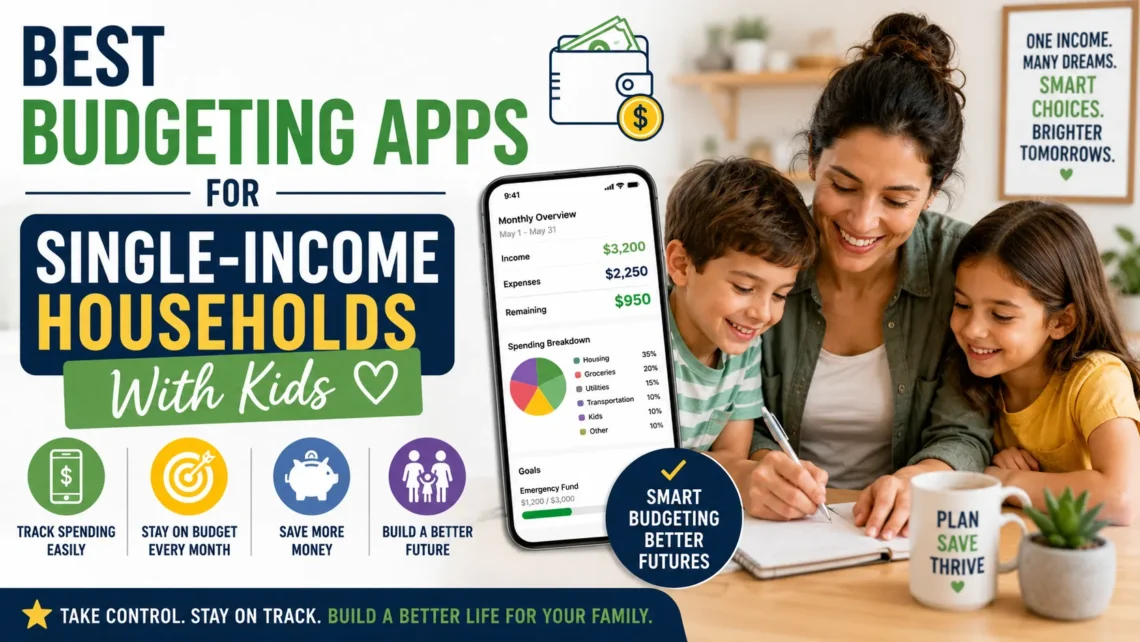
When my brother-in-law went down to one income after his wife stayed home with their second baby, he told me something that stuck with me: “We are not broke. We are just blind.” That is the real problem in a single-income house with kids. The money is not always missing. You just cannot see where it goes fast enough to stop it before it is gone.
I have tested a handful of budgeting apps over the past year, partly for my own house and partly because people keep asking me which one actually works when there is only one paycheck coming in and a few small mouths to feed. So here is my honest answer, written the way I would explain it to a friend over coffee, not a finance textbook.
Quick Answer: The Best Budgeting Apps for Single-Income Families With Kids
If you want the short version before you keep reading:
- Goodbudget — best free option, good for beginners who want to “see” their money in envelopes
- YNAB (You Need A Budget) — best if your income is steady but your expenses are not, strong for families with school costs, activities, and surprise bills
- PocketGuard — best if you just want one number that tells you what is safe to spend today
- EveryDollar — best if you like a simple, no-fuss zero-based system without a learning curve
Now let me walk you through why, with real examples from real households like mine.
Why Single-Income Families With Kids Need a Different Approach
Most budgeting advice online is written for two incomes, or for a single person with no kids. Neither of those situations is yours. When you are running a household on one paycheck and there are children involved, three things happen that most budgeting apps were not built for:
- One missed paycheck and the whole month wobbles. There is no second income to cover the gap.
- Kids create expenses that do not show up every month. School supplies in August, a doctor visit in February, a birthday party in May. These are “surprise” costs only if you are not planning for them.
- There is usually only one person watching the money. That person needs an app that is fast to check, not a finance project that eats their evening.
So when I judge an app for this article, I am not asking “is this the most powerful budgeting tool out there.” I am asking “can a tired parent open this on their phone in two minutes and actually know where they stand.”
1. Goodbudget — Best Free App for Beginners
My sister-in-law started here, and I think it is still the easiest on-ramp for a single-income family that has never used a budgeting app before.
Goodbudget uses the old “envelope” method, just digital. You decide how much goes into the groceries envelope, the gas envelope, the kids’ clothes envelope, and so on. Once an envelope is empty, that is your sign to stop spending in that category, not a credit card swipe waiting to happen.
How it works in real life: Say you put $400 into the groceries envelope for the month. You buy $90 of groceries on week one. Your app now shows $310 left, in plain sight, every time you open it. No math. No guessing. Just a number going down.
What I like about it for families: You can create an “Annual Envelope” for things that only happen once a year, like the kids’ back-to-school shopping or holiday gifts. You set a target amount and a due date, and the app quietly helps you save toward it month by month instead of getting hit with the full bill in August.
The catch: The free version caps you at 10 envelopes and one account. For a family juggling groceries, gas, school costs, clothes, activities, and savings, 10 envelopes fills up fast. The paid Premium plan is $10 a month or $80 a year and removes that limit, plus lets up to five family devices stay in sync.
Who this is for: A single-income parent who has never budgeted before and wants something visual, simple, and free to start with.
2. YNAB (You Need A Budget) — Best for Families With Uneven Expenses
YNAB is the app that finally made budgeting click for a friend of mine whose husband works seasonal construction. Her income is steady but her husband’s overtime is not, and YNAB’s whole philosophy is built for exactly that kind of unevenness.
The idea behind YNAB is simple to say and a little harder to live by at first: every dollar gets a job the moment it lands in your account. Not “I’ll figure out the categories at the end of the month.” Right when the paycheck hits, you decide on the spot — this goes to rent, this goes to daycare, this goes to the car payment that is due in three weeks even though it is not due today.
A real scenario: Picture a single-income household where the paycheck comes on the first of the month. Rent is due on the 5th, the car insurance is due on the 20th, and soccer registration for the kids is due in March even though it is only January. With YNAB, you assign money toward all three the moment you get paid, not when the bill shows up. By the time soccer registration rolls around, the money is already sitting there waiting, instead of becoming a scramble.
Family-specific features: One subscription, called YNAB Together, covers up to six people. That means you, your partner, and even older kids can log in and see the same budget on their own devices. There is also a Debt Payoff feature if you are working down a credit card or car loan, which keeps that goal visible next to your everyday spending instead of being a separate, forgotten plan.
The honest downside: YNAB takes some getting used to. Most people need two to three weeks before the system feels natural instead of fiddly. It is also the priciest app on this list — $14.99 a month or $109 a year, though splitting that across a household of six brings the per-person cost way down. There is a 34-day free trial with no credit card required, so you can test it through a full pay cycle before deciding.
Who this is for: Families where income or expenses are not perfectly predictable month to month and you want a system that forces a plan before the spending happens, not after.
3. PocketGuard — Best for “How Much Can I Actually Spend Today”
Some parents do not have the time or patience for envelopes or zero-based budgeting. They just want to open an app and see one honest number: how much is safe to spend right now, after the bills are covered.
That is exactly what PocketGuard does with its “In My Pocket” feature. It connects to your bank accounts, looks at your bills and savings goals, and shows you a single number for what is actually free to spend today.
Why this matters for a one-income household: When there is only one paycheck and you are the one keeping track, decision fatigue is real. You do not always have the mental energy to check five different envelope balances before saying yes or no to a $40 trip to the toy store. One clear number cuts that decision time down to a glance.
The tradeoff: PocketGuard does not have real multi-user access, so if both parents want their own full view, you are sharing one login. For a single-income family where one person manages the money and the other just wants a heads-up, that is usually not a problem. The free plan covers basic tracking, and PocketGuard Plus is $12.99 a month or $74.99 a year if you want unlimited accounts and the debt payoff planner.
Who this is for: The parent who manages all the money solo and wants speed over detail — open app, see number, make decision, move on with your day.
4. EveryDollar — Best for a Simple, No-Frills Zero-Based Budget
If YNAB sounds like too much homework, EveryDollar is the simpler cousin. It is built by Dave Ramsey’s team and follows the same “give every dollar a job” idea, but with a cleaner, more beginner-friendly screen.
How a single-income family might use it: You list your income for the month, then build categories — groceries, childcare, gas, kids’ activities — until every dollar of that one paycheck has a place to go. There is no bank-syncing on the free version, so you are typing in expenses by hand, which sounds tedious but actually keeps a lot of families more aware of what they are spending, since you have to look at the number before you log it.
What stands out for families specifically: EveryDollar relaunched its app in early 2026 with a “margin finder” feature that scans your budget for breathing room you might have missed, plus short daily lessons if you want to build budgeting habits slowly instead of all at once.
The catch: Bank sync, custom reports, and habit-based recommendations are locked behind the Premium version at $17.99 a month or $79.99 a year. The free version works, but you are doing manual entry the whole way.
Who this is for: A parent who wants the zero-based method without YNAB’s learning curve, and does not mind typing in a few transactions by hand each day.
How to Pick the Right One for Your Family
Honestly, the “best” app depends less on features and more on your situation. Here is a simple way to think it through:
- If your income is steady but expenses are lumpy (school fees, seasonal bills, sports), go with YNAB.
- If you want to start free and like seeing money visually disappear from a category, go with Goodbudget.
- If you are the only one managing money and just want a fast daily check, go with PocketGuard.
- If you want zero-based budgeting without a steep learning curve, go with EveryDollar.
Best Tax Software for Freelancers With Multiple 1099 Clients
Frequently Asked Questions
Is it worth paying for a budgeting app on one income?
If the app helps you avoid even one late fee, one overdraft charge, or one “I forgot that bill was due” moment, it usually pays for itself. Start with a free tier first. Upgrade only if you hit its limits, like running out of envelope slots in Goodbudget or needing bank sync in EveryDollar.
Can my kids use a budgeting app too?
YNAB allows up to six people on one household plan, so older kids or teens can have their own login and see (or even help manage) the family budget. This is also a quiet way to teach them money skills before they move out.
What if my income changes month to month, like overtime or gig work?
Zero-based budgeting apps like YNAB and EveryDollar handle this best, since you assign jobs to money as it arrives rather than predicting a fixed amount ahead of time.
Do I need to connect my bank account?
No. Goodbudget’s free plan and EveryDollar’s free plan both work with manual entry, no bank connection required. This is actually a plus for privacy-minded families, though it does mean typing in your own transactions.
What is the cheapest way to budget as a one-income family?
Goodbudget’s free tier costs nothing and includes 10 envelopes, which is enough for most basic categories (groceries, gas, bills, kids, savings). It is the easiest free starting point on this list.
My Honest Take
If I had to pick just one for a single-income family with kids starting from zero, I would say start with Goodbudget because it is free and forgiving while you build the habit, then move to YNAB once you are ready to get serious about planning ahead for the irregular stuff — school fees, holidays, the car that always seems to need something in November.
The app is not what fixes your budget. It is the habit of opening it every few days that does. Pick the one that feels the least like a chore, and you will actually stick with it long enough for it to work.