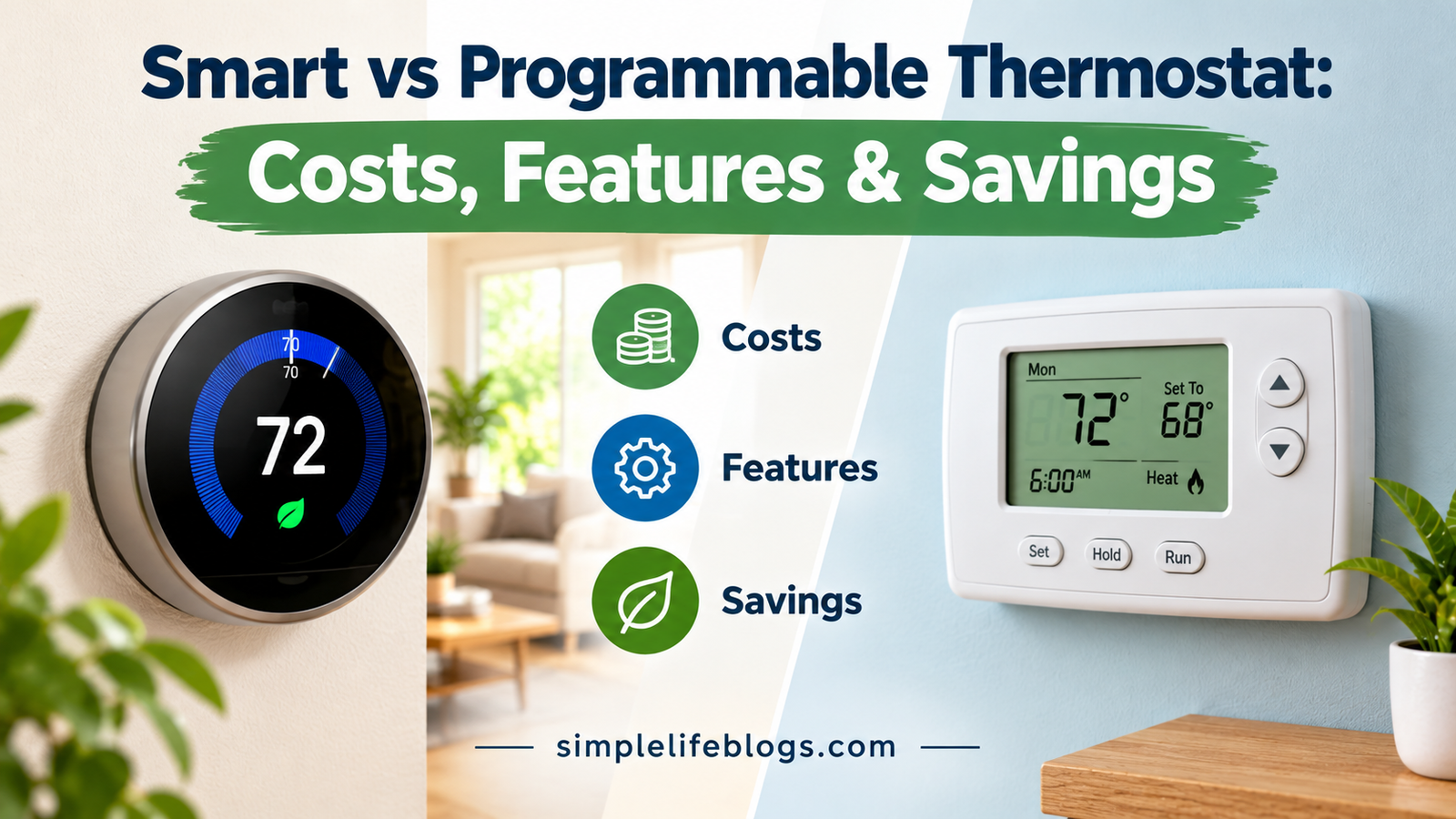
Smart vs Programmable Thermostat: Costs, Features & Savings
If your heating and cooling bills feel too high, your thermostat is a good place to start. It decides when your system runs and how hard it works.
The two main upgrade options are the programmable thermostat and the smart thermostat. They look similar on the wall, but they work differently, cost different amounts, and suit different households.
This guide compares smart vs programmable thermostat options on automation, scheduling, installation, price, and potential savings. It does not promise a fixed return, because real savings depend on your home, your climate, and your habits.
Quick Answer: Which One Should You Choose?
- Choose a programmable thermostat if your schedule is steady, you want the lowest upfront cost, and you are happy to set a simple weekly routine.
- Choose a smart thermostat if your schedule changes often, you want remote control from your phone, or you want the thermostat to adjust on its own.
Neither one saves energy by itself. Savings come from running your system less when nobody needs it. Both types can do that, but they get there in different ways.
Smart vs Programmable Thermostat at a Glance
| Feature | Programmable Thermostat | Smart Thermostat |
|---|---|---|
| Typical price range | Roughly $25–$100 | Roughly $100–$300 |
| Scheduling | Fixed weekly schedule you set manually | Schedules plus learning or automatic adjustments |
| Remote control | No | Yes, through an app |
| Wi-Fi required | No | Usually yes |
| Occupancy or location sensing | No | Often yes (geofencing or sensors) |
| Energy reports | No | Often yes |
| Voice assistant support | No | Often yes |
| Installation difficulty | Usually easy | Easy to moderate; may need a C-wire |
| Best for | Predictable routines, tight budgets | Changing schedules, convenience, data |
Prices vary by brand, features, and region. Check current prices before you buy.
What Is a Programmable Thermostat?
A programmable thermostat lets you set temperatures for different times of day. For example, you can lower the heat while you are at work and raise it before you get home.
Most models offer one of these schedule types:
- 7-day: a different schedule for each day
- 5-2: one schedule for weekdays, another for weekends
- 5-1-1: one for weekdays, one for Saturday, one for Sunday
Once you set the schedule, the thermostat repeats it every week. It does not know whether you are home. It follows the clock.
Pros of a Programmable Thermostat
- Lower upfront cost
- Simple, with no app or Wi-Fi needed
- Works well for a steady routine
- Fewer things to go wrong
Cons of a Programmable Thermostat
- You have to program it yourself, and many people never do
- It cannot adapt if your plans change
- No remote access
- Many models have small screens and confusing menus
That last point matters. A programmable thermostat only helps if you set it up and keep the schedule accurate. Many households leave it on the factory settings or override it by hand, and then it saves very little.
What Is a Smart Thermostat?
A smart thermostat connects to your home Wi-Fi. You can control it from a phone app, a web page, or a voice assistant. Many models also automate part of the job.
Common smart features include:
- Remote control: change the temperature from anywhere
- Learning schedules: some models watch your habits and build a schedule
- Geofencing: the thermostat uses your phone’s location to know when you leave or return
- Room sensors: some systems measure temperature or occupancy in other rooms
- Energy reports: see how many hours your system ran
- Alerts: warnings about extreme temperatures or system problems
- Utility program support: some models can join demand-response programs that may offer bill credits
Pros of a Smart Thermostat
- Adjusts to changing schedules
- Control from anywhere
- Less manual programming
- Usage data helps you spot patterns
- Some utilities offer rebates on qualifying models
Cons of a Smart Thermostat
- Higher upfront cost
- Needs Wi-Fi and a working app
- Some models need a C-wire (common wire)
- Privacy considerations, since the device collects usage data
- A learning feature may need correction if it picks up the wrong habits
Automation and Scheduling Compared
This is the biggest difference between the two.
Programmable thermostats run on rules you create. If you leave the house early one day, the thermostat will not know. It will heat or cool an empty home until the schedule says otherwise.
Smart thermostats can respond to real life. With geofencing or occupancy sensors, they can move to an energy-saving setting when the house is empty and return to a comfortable setting when someone comes back. Some also use weather data to adjust how they run.
If your days look the same week after week, a programmable thermostat may be all you need. If you work shifts, travel, work from home on different days, or have unpredictable plans, the extra automation of a smart thermostat is more useful.
Installation: What to Expect
Installing a Programmable Thermostat
Many homeowners replace a basic thermostat with a programmable one themselves. The general steps are:
- Turn off power to your heating and cooling system at the breaker.
- Remove the old thermostat and label each wire.
- Mount the new base plate and connect the wires to the matching terminals.
- Attach the thermostat, restore power, and set the schedule.
Installing a Smart Thermostat
The process is similar, with a few extra steps: connecting to Wi-Fi, creating an account, and downloading the app.
The most common problem is the C-wire. This wire gives the thermostat steady power. Older homes may not have one. Some smart thermostats include a power adapter kit, and others may need an electrician or a new wire run.
Compatibility Checks Before You Buy
- Check that the thermostat works with your system type (furnace, heat pump, boiler, multi-stage, or dual-fuel).
- Check whether your home has a C-wire.
- Line-voltage systems, such as electric baseboard heaters, need thermostats made for that voltage. A standard low-voltage thermostat will not work.
- Read the manufacturer’s compatibility checker and installation manual.
Always follow the manufacturer’s instructions and your local electrical and building requirements. If you are not comfortable working with wiring, hire a licensed HVAC technician or electrician.
Cost Comparison
Upfront Cost
- Programmable thermostats: often $25–$100
- Smart thermostats: often $100–$300, depending on brand and sensors
- Professional installation: can add roughly $100–$250 or more, depending on your area and wiring
Possible Extra Costs
- A C-wire adapter or new wiring
- Extra room sensors
- A subscription for advanced features (some brands offer optional paid plans)
Rebates
Some utility companies and local programs offer rebates or bill credits on qualifying smart thermostats. Check your utility’s website before you buy, since the offer may change what you pay.
Smart Thermostat Guide: Settings, Compatibility and Savings
Potential Savings: What the Evidence Says
No thermostat can promise a specific dollar amount. Still, there are useful reference points.
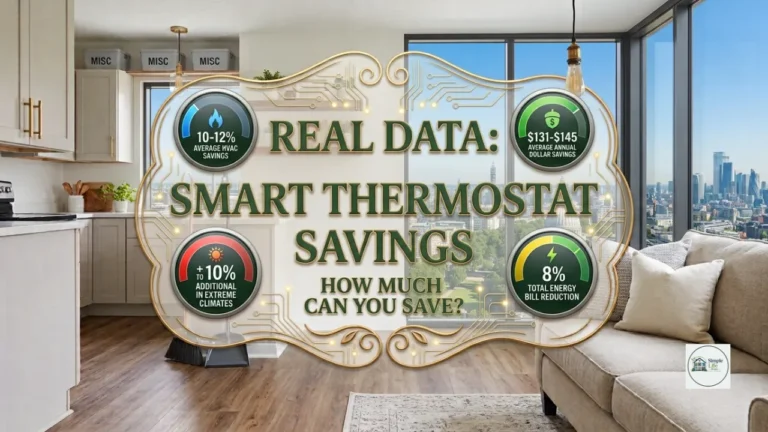
The U.S. Department of Energy says you can save up to about 10% a year on heating and cooling by turning your thermostat back 7–10°F for eight hours a day from your normal setting. That saving comes from the setback behavior, not from the type of device. A programmable thermostat can do this. So can a smart thermostat, or even a manual thermostat if you adjust it every day.
For smart thermostats, ENERGY STAR has estimated average savings of around 8% on heating and cooling costs for certified models. Some manufacturer-sponsored studies report higher numbers. Treat those with care, because the results come from specific test conditions.
What Affects Your Real Savings
- Climate: colder or hotter regions have more to save
- Home insulation and air sealing: a leaky home loses much of any gain
- Your HVAC system: efficiency and type matter
- Your habits: how often you are away, and how well you use the schedule
- Energy prices: higher rates make each saved hour worth more
- Setpoint choices: setting wider temperature gaps usually saves more
Do Programmable Thermostats Actually Save Money?
They can, but only when used properly. The main problem is human behavior. If a schedule is too hard to set or does not match your life, people override it. A programmable thermostat that is never programmed saves nothing.
Do Smart Thermostats Pay for Themselves?
It depends. A household with big temperature swings, irregular schedules, and high energy bills may recover the extra cost sooner. A household that is home most of the time, in a mild climate with low energy costs, may take much longer, or may not recover the cost through savings alone. Comfort and convenience may be the real benefits in that case.
A simple way to estimate your own case:
- Look at your yearly heating and cooling spend.
- Apply a cautious range, such as 3%–8%, rather than the highest claims.
- Subtract that from the extra cost of a smart model over a programmable one.
This is only a rough planning tool, not a guarantee.
Which Thermostat Fits Your Situation?
A programmable thermostat may be better if:
- You have a regular 9-to-5 routine
- You want the lowest cost
- You do not want an app or Wi-Fi device
- You are comfortable setting a schedule once and leaving it
A smart thermostat may be better if:
- Your schedule changes from week to week
- You travel or work shifts
- You want to adjust the temperature from your phone
- You want usage reports and alerts
- Your utility offers a rebate that cuts the price
You may not need either if:
- You already adjust your manual thermostat by hand each day and it works for you
- Your heating system is not compatible with the options you are looking at
Tips to Get More Out of Either Type
- Set realistic setbacks. A change of several degrees while you are away or asleep is more useful than a tiny change.
- Review the schedule every season. Your routine at home may change.
- Avoid constant overrides. Frequent manual changes can undo the schedule.
- Place it well. Keep the thermostat away from direct sunlight, drafts, and heat sources.
- Seal and insulate. Air leaks and poor insulation can cancel out thermostat savings.
- Maintain your HVAC system. Replace filters and schedule regular service.
- Be careful with heat pumps. Some heat pumps need specific settings, and big setbacks can trigger costly backup heating. Follow the manufacturer’s guidance.
Frequently Asked Questions
Is a smart thermostat worth it over a programmable one?
It can be, if your schedule is irregular or you value remote control and automation. If your routine is steady and your budget is tight, a programmable thermostat may be enough.
Can I install a smart thermostat myself?
Many people do, but it depends on your wiring and system. Check compatibility first and turn off power at the breaker. Hire a licensed professional if you are unsure.
Do smart thermostats work without Wi-Fi?
Most keep basic heating and cooling control without Wi-Fi, but remote control, updates, and some automation features will not work until the connection returns.
Do I need a C-wire for a smart thermostat?
Many models need one, but some include an adapter or can run with other wiring setups. Check the manufacturer’s compatibility tool.
How much can I save with a smart thermostat?
Savings vary. Published estimates are often in the single digits to low double digits as a percentage of heating and cooling costs, but your result depends on your home, climate, and habits.
Is a programmable thermostat the same as a smart thermostat?
No. A programmable thermostat follows a schedule you enter. A smart thermostat connects to the internet and can add remote control, learning, and automatic adjustments.
Will a smart thermostat work with my heat pump or boiler?
Some do, some do not. Compatibility depends on the system type and wiring, so check the product’s specifications and installation guide before buying.
Final Thoughts
The real difference between a smart and a programmable thermostat is how much work you do yourself. A programmable model saves money when you set it up well and follow the schedule. A smart model does more of that work for you and fits changing lives better, but costs more.
Pick the one that matches how you actually live. The best thermostat is the one you will use correctly. Before buying, check your system’s compatibility, read the manufacturer’s instructions, and follow your local electrical and building requirements.