

Money stress shows up in almost every corner of family life. It’s there when the grocery bill comes to more than expected, when a car repair eats into savings, and when parents lie awake wondering if they’re doing enough to prepare their kids for the future. The good news is that family financial planning isn’t about being perfect with money. It’s about building a system that helps a household make steady, informed decisions — even when life throws a curveball.
This guide is meant to be the starting point. It won’t cover every topic in exhaustive detail (that’s what the dedicated guides linked throughout this article are for), but it will give you a complete picture of how family financial planning works, what to prioritize, and where to go deeper.
Quick Answer: What Is Family Financial Planning?
Family financial planning is the ongoing process of managing a household’s income, expenses, savings, debt, and long-term goals in a coordinated way. It typically includes budgeting, building an emergency fund, managing debt, saving for big purchases like a home, planning for children’s expenses, and working toward long-term goals like retirement. A financial plan isn’t a one-time document — it’s a habit that gets revisited as a family’s income, expenses, and goals change.
Every family needs some version of a financial plan, whether that’s a newly married couple figuring out how to combine finances, a single-income household trying to stretch a budget, or a family with school-age kids trying to save for college and retirement at the same time.
What Is Family Financial Planning?
At its core, family financial planning is the practice of aligning money decisions with a household’s values and goals. It answers questions like: How much can we spend without falling behind? How much should we save? What happens if someone loses a job? How do we prepare for retirement while also paying for kids’ activities today?
Unlike individual financial planning, family financial planning has to account for multiple people, sometimes multiple incomes (or just one), and often a mix of short-term needs (like childcare) and long-term goals (like retirement or college).
Why Every Family Needs a Financial Plan
Many families assume financial planning is only for people who are wealthy or close to retirement. In reality, the earlier a family starts planning, the more room they have to adjust course before small problems become big ones.
A financial plan gives a family:
- A clear picture of where money is going each month
- A cushion for unexpected expenses
- A path toward major goals like homeownership
- Less day-to-day stress about money
- A shared understanding between partners about priorities
Many families discover that the biggest benefit of financial planning isn’t the numbers themselves — it’s the reduced anxiety that comes from knowing there’s a plan in place.
The Biggest Financial Challenges Families Face
A few challenges show up again and again:
- Rising costs of childcare, housing, and groceries outpacing income growth
- Single-income households trying to cover expenses that used to require two incomes
- Lack of an emergency fund, which turns small setbacks into debt
- Competing goals — saving for a house while also saving for retirement and paying down debt
- Lifestyle inflation, where spending increases as income increases, leaving little left to save
For example, a family earning $75,000 a year might feel like they’re falling behind not because they’re bad with money, but because they never built a system for where money should go before it’s spent.
Building a Strong Family Budget
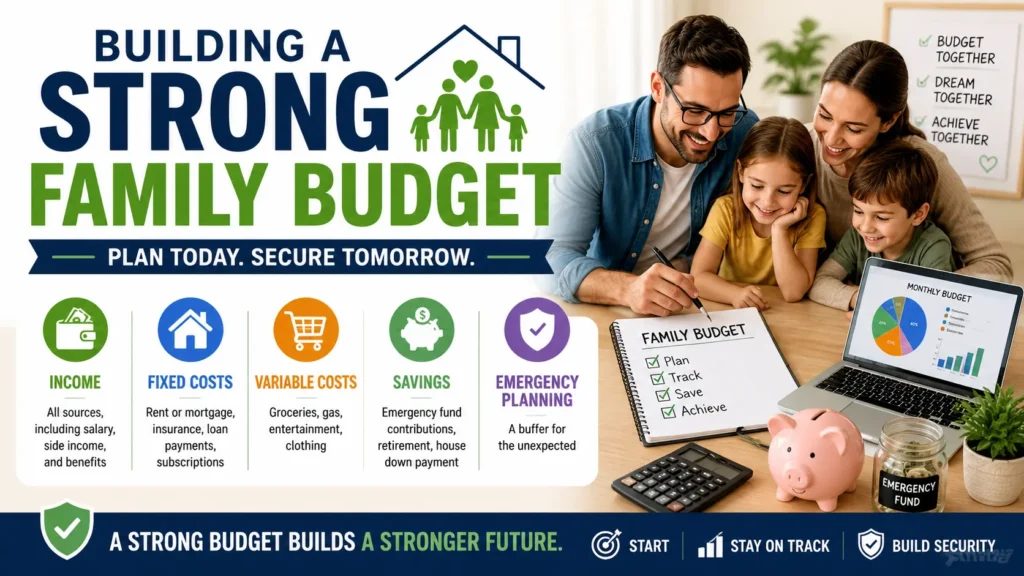
A budget is simply a plan for your income before you spend it. For families, this usually means accounting for:
- Income — all sources, including salary, side income, and benefits
- Fixed costs — rent or mortgage, insurance, loan payments, subscriptions
- Variable costs — groceries, gas, entertainment, clothing
- Savings — emergency fund contributions, retirement, house down payment
- Emergency planning — a buffer for the unexpected
One common mistake families make is building a budget around take-home pay without first setting aside savings. Financial educators often recommend treating savings like a fixed expense — something that gets paid before discretionary spending, not whatever is left over at the end of the month.
If your family is just getting started, a simple percentage-based framework can help: a common starting point is roughly 50% of income toward needs, 30% toward wants, and 20% toward savings and debt repayment. This isn’t a strict rule, but it’s a useful baseline to adjust from.
For families managing on one income, our guide to the Best Budgeting Apps for Single-Income Households With Kids breaks down tools designed specifically for tighter margins and irregular expenses.
If you’re building your budgeting system from scratch, How to Create a Family Budget That Actually Works walks through a step-by-step process that goes beyond generic budgeting advice.
For a printable or digital starting point, check out our Monthly Budget Template for Families, and if you’d rather have the math done for you, our Family Budget Calculator Guide explains how to use budgeting calculators to model different income and expense scenarios.
Common Family Budget Categories
| Category | Typical Share of Income | Notes |
|---|---|---|
| Housing (rent/mortgage) | 25–35% | Includes property tax and insurance if owned |
| Utilities | 5–10% | Varies by climate and home size |
| Groceries | 10–15% | Higher for larger families |
| Transportation | 10–15% | Includes car payment, gas, insurance |
| Childcare | 5–20% | Can be one of the largest costs for young families |
| Debt payments | 5–15% | Excludes mortgage |
| Savings | 10–20% | Emergency fund, retirement, goals |
| Discretionary | 5–10% | Entertainment, dining out, hobbies |
Saving Money as a Family
Saving money as a family isn’t just about cutting expenses — it’s about building habits that stick. Many families discover that small, consistent changes add up faster than occasional big cuts that are hard to maintain.
A few starting habits worth considering:
- Automating transfers to savings right after payday
- Reviewing subscriptions every few months
- Meal planning to reduce food waste
- Setting a specific savings goal with a timeline, rather than a vague “save more” intention
Long-term saving works best when it’s tied to a specific purpose — a home down payment, a car replacement fund, or a vacation — rather than left open-ended.
For a deep list of ideas, 50 Practical Ways Families Can Save Money Every Month covers everything from utility savings to subscription audits. Since groceries are one of the largest variable expenses for most households, How to Save Money on Groceries Without Sacrificing Quality is worth a look if food costs feel out of control.
Creating an Emergency Fund
An emergency fund is money set aside specifically for unplanned expenses — a job loss, medical bill, or major car repair. It’s separate from regular savings goals like a vacation or a new appliance.
Why it matters: Without an emergency fund, unexpected expenses often end up on a credit card, which can turn a one-time problem into ongoing debt.
How much to save: A commonly recommended target is three to six months of essential expenses, though families with variable income or a single earner sometimes aim higher. There’s no single right number — the goal is enough of a cushion to avoid going into debt for common emergencies.
Where to keep it: Emergency funds are generally kept somewhere safe and accessible, such as a savings account, rather than invested in the stock market, since the money may be needed on short notice.
For a full breakdown of how to build this fund step by step, see our Emergency Fund Guide for Families. If you’re unsure how an emergency fund differs from your regular savings account, Emergency Fund vs Savings Account explains the distinction.
Choosing the Right Savings Account
Not all savings accounts work the same way, and the right choice often depends on what the money is for.
- Traditional savings accounts are widely available and simple, though they often pay lower interest rates.
- High-yield savings accounts typically offer higher interest rates and are commonly used for emergency funds and short-term goals.
- Certificates of deposit (CDs) lock money away for a fixed term in exchange for a set interest rate, which can work well for money you won’t need soon.
- Joint accounts allow married couples to manage shared expenses and savings goals together.
If your family is saving toward a home, our guide to the Best Savings Accounts for Families Saving for a House Down Payment compares account types suited to that specific goal. To understand the difference between account types more broadly, see Best High-Yield Savings Accounts Explained and CD vs High-Yield Savings Account.
For couples deciding how to structure shared finances, Best Joint Bank Accounts for Married Couples covers what to look for.
Savings Account Comparison
| Account Type | Typical Use | Liquidity | Interest Potential |
|---|---|---|---|
| Traditional Savings | General savings | High | Low |
| High-Yield Savings | Emergency fund, short-term goals | High | Moderate–High |
| CD | Money not needed soon | Low (penalty for early withdrawal) | Moderate–High |
| Joint Account | Shared household expenses | High | Varies |
Managing Family Spending
Tracking expenses is one of the simplest ways to understand where money is actually going, as opposed to where a family thinks it’s going. One common mistake families make is estimating expenses based on memory rather than actual data — and often underestimating categories like dining out or subscriptions.
A few patterns worth watching for:
- Lifestyle inflation — spending more as income rises, which can quietly erase the benefit of a raise
- Subscription creep — small recurring charges that add up over time
- Impulse purchases — often triggered by stress or convenience rather than planning
For busy parents, Best Expense Tracking Apps for Busy Parents highlights tools that simplify this process. If you want to see the most frequent pitfalls families run into, Budgeting Mistakes Families Make goes into detail. And since prices don’t stay the same year to year, How Inflation Affects Family Budgets explains how rising costs affect a household’s purchasing power over time.
Credit Cards for Families
Used responsibly, credit cards can offer rewards on everyday spending categories like groceries and gas. Used without a plan, they can quickly become a source of high-interest debt.
Families considering a rewards credit card generally want to weigh:
- Cash back or points on categories they already spend in, like groceries and gas
- Annual fees versus the value of rewards earned
- Interest rates, which matter most if a balance is ever carried month to month
Credit cards are best suited to families who can pay the balance in full each month. Carrying a balance often erases the value of any rewards earned, since interest charges typically outweigh cash back or points.
For grocery- and gas-heavy households, Best Credit Cards for Families With High Grocery and Gas Spending compares options built around those categories. For a broader look, Best Cash Back Credit Cards for Parents covers cards suited to general family spending.
Preparing to Buy a Home
Buying a home is one of the biggest financial decisions a family will make, and preparation typically starts well before house hunting begins.
Credit score: Lenders use credit scores to determine loan eligibility and interest rates. A higher score generally leads to better loan terms.
Savings: Beyond the down payment, families typically need savings for closing costs, moving expenses, and a maintenance cushion after the purchase.
Affordability: Lenders often look at debt-to-income ratio to determine how much a family can borrow, but that figure doesn’t always match what feels comfortable for a household’s actual budget.
Down payment: Down payment requirements vary by loan type, and some programs allow for lower down payments than the traditional 20% figure many people assume is required.
If credit history needs work before applying for a mortgage, How to Improve Your Credit Score Before Buying a House walks through common strategies. To think through what a comfortable monthly payment actually looks like for your household, How Much House Can Your Family Actually Afford? goes beyond the lender’s maximum approval amount. And if you’re starting your down payment savings from zero, How to Save $10,000 for a House Down Payment offers a practical savings timeline.
Paying Off Debt vs Saving

This is one of the most common questions families face, and there’s no universal answer — it depends on the type of debt, the interest rate, and the family’s financial cushion.
The case for paying off debt first: High-interest debt, like credit card balances, often costs more in interest than most savings accounts or investments earn. Paying it down quickly can free up cash flow.
The case for saving first: Without at least a small emergency fund, families paying off debt often end up back in debt the moment an unexpected expense hits.
A common middle-ground approach: build a small starter emergency fund first (often around $1,000, though this varies by household), then aggressively pay down high-interest debt, then build the emergency fund up to a fuller three-to-six-month cushion.
Our guide Should Families Pay Off Debt or Save First? walks through how to weigh these priorities based on your specific situation.
Building Long-Term Family Wealth
Long-term wealth building typically involves a combination of investing, retirement planning, and college savings — often happening at the same time, which can feel overwhelming for families juggling current expenses too.
Investing basics: For most families, long-term investing happens through retirement accounts like a 401(k) or IRA, which offer tax advantages designed to encourage long-term saving.
Retirement: Many financial educators recommend prioritizing retirement savings even while paying for children’s needs, since retirement can’t be funded with loans the way college can.
College savings: Accounts like 529 plans allow families to save for education expenses with tax benefits in many states, though families should weigh this goal against retirement savings.
Net worth: Tracking net worth (assets minus debts) over time gives families a clearer long-term picture than monthly income alone.
For families wanting a broader framework, How to Build Wealth as a Middle-Class Family discusses realistic, non-flashy strategies. To set clear priorities for the months ahead, Best Financial Goals Every Family Should Set This Year offers a starting checklist. And for managing periodic large expenses (holiday gifts, car maintenance, annual insurance premiums), Sinking Funds Explained for Families covers a strategy many families find useful for smoothing out irregular costs.
Family Financial Planning by Life Stage
Newly Married Couples
Combining finances is one of the first major money decisions a couple makes. Many couples discover that talking openly about debt, spending habits, and financial goals early on prevents bigger conflicts later. Our Financial Checklist for Newly Married Couples covers the key conversations and steps worth having early.
Planning for Children
Childcare, medical costs, and everyday expenses increase significantly with a new child. Many families find it helpful to review their budget and insurance coverage before the baby arrives, rather than after. See Financial Planning Checklist Before Having Kids for a pre-baby financial review.
Families With School-Age Children
At this stage, families often juggle activity costs, school expenses, and the early stages of college savings, all while trying to stay on track with retirement.
Families Saving for Retirement
Even with kids still at home, many financial educators recommend continuing retirement contributions, particularly to capture any employer match, since that’s generally considered one of the more straightforward ways to build long-term savings.
Common Family Money Mistakes
A few mistakes show up repeatedly across households of different income levels:
- Overspending relative to income, often without realizing it until reviewing actual bank statements
- No emergency fund, leaving little room for the unexpected
- Carrying high-interest debt for extended periods
- Skipping insurance coverage to save on premiums, which can backfire if a major event occurs
- Lifestyle inflation that outpaces income growth
- Delaying retirement savings, assuming there will be more time later
For a closer look at each of these and how to course-correct, see The Biggest Family Money Mistakes (And How to Avoid Them).
Family Financial Planning Checklist
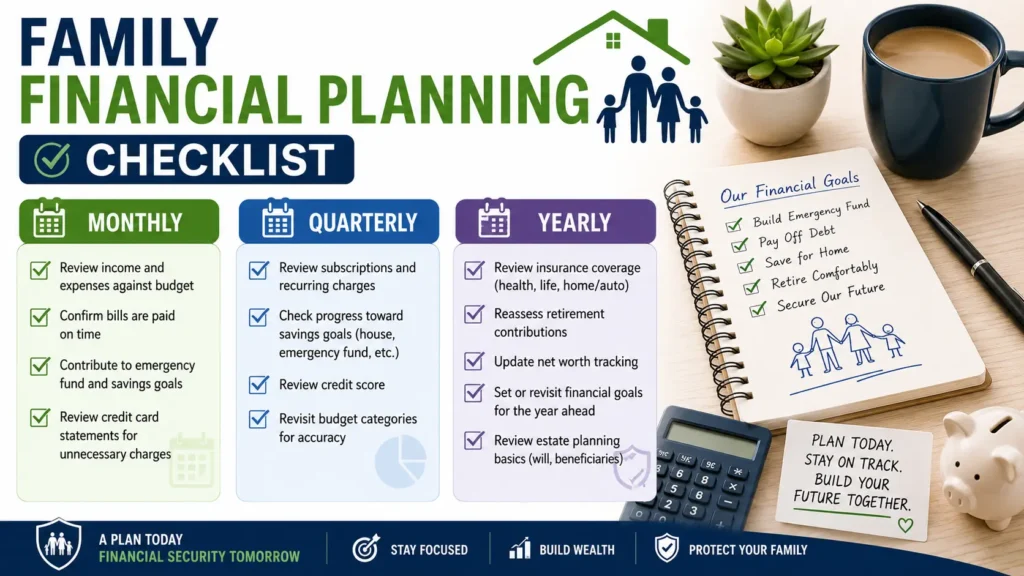
Monthly
- Review income and expenses against budget
- Confirm bills are paid on time
- Contribute to emergency fund and savings goals
- Review credit card statements for unnecessary charges
Quarterly
- Review subscriptions and recurring charges
- Check progress toward savings goals (house, emergency fund, etc.)
- Review credit score
- Revisit budget categories for accuracy
Yearly
- Review insurance coverage (health, life, home/auto)
- Reassess retirement contributions
- Update net worth tracking
- Set or revisit financial goals for the year ahead
- Review estate planning basics (will, beneficiaries)
Recommended Resources
Beyond this guide, a few categories of resources can help families go deeper:
- Budgeting apps that automate expense tracking and categorization
- Financial calculators for mortgages, savings goals, and retirement projections
- Books written for everyday families rather than professional investors
For a curated list, see Best Family Finance Books Worth Reading.
Frequently Asked Questions
How much should families save every month?
A common guideline is around 20% of income toward savings and debt repayment, though this varies based on income, cost of living, and existing debt.
How big should an emergency fund be?
Most financial educators recommend three to six months of essential expenses, though single-income households sometimes aim for a larger cushion.
Should we pay off debt or save first?
Many families start with a small emergency cushion, then focus on high-interest debt, then build savings further. The right order depends on interest rates and financial stability.
Should couples combine finances?
There’s no single right answer. Some couples combine everything, others keep some accounts separate while sharing joint expenses. What matters most is transparency and agreement on shared goals.
How much house can we afford?
Lender pre-approval amounts don’t always match what feels comfortable month to month. Many financial educators suggest looking at total housing costs as a percentage of take-home pay, not just the mortgage payment alone.
How do we start budgeting if we’ve never done it before?
Start by tracking actual spending for a month before creating a plan. This gives a realistic baseline rather than guesswork.
Is it too late to start financial planning?
No. Financial planning is valuable at any stage, whether starting in your twenties or your fifties.
How much life insurance does a family need?
This depends on income, debts, and dependents. Many families use a multiple of annual income as a starting point, then adjust based on specific obligations like a mortgage or college costs.
Should we save for college or retirement first?
Many financial educators suggest prioritizing retirement, since loans are available for college but not for retirement.
What percentage of income should go to housing?
A common guideline suggests keeping housing costs around 25–30% of take-home pay, though this varies by location and household circumstances.
How do we handle one income after a job loss or new baby?
Reviewing fixed expenses, pausing non-essential savings goals temporarily, and drawing carefully from an emergency fund are common strategies during single-income transitions.
What’s the difference between a budget and a financial plan?
A budget manages monthly income and expenses. A financial plan is broader, covering long-term goals like retirement, home buying, and debt payoff.
How often should we review our budget?
Monthly reviews are common, with a deeper quarterly check-in on savings goals and larger financial changes.
Do we need a financial advisor?
Some families benefit from professional guidance, especially for complex situations like estate planning or investment strategy. Others manage their own planning successfully with the right resources.
What’s a sinking fund?
A savings category set aside for a specific, planned future expense — like holiday gifts or car maintenance — so it doesn’t disrupt the regular budget when it comes due.
How do we teach kids about money?
Many families start with simple concepts like saving, spending, and giving, using age-appropriate allowances or chore-based systems.
Should we buy or rent a home?
This depends on financial readiness, local housing costs, and how long a family plans to stay in one place. There’s no universally correct answer.
How much should we spend on childcare?
Childcare costs vary widely by location and type of care. Many families find it helpful to compare childcare costs against potential income before making decisions about work arrangements.
What’s the fastest way to improve our finances?
Building a realistic budget and an emergency fund tend to have the most immediate impact, since they reduce the chance of new debt from unexpected expenses.
Final Thoughts
Family financial planning isn’t about hitting every target perfectly or never making a mistake. It’s about building habits — budgeting, saving consistently, managing debt thoughtfully, and revisiting the plan as life changes — that move a household in the right direction over time.
If your family is just getting started, pick one area from this guide — whether that’s building a budget, starting an emergency fund, or reviewing your savings account options — and begin there. The rest of this guide, along with the dedicated articles linked throughout, will be here as your family works through each stage.
Progress, not perfection, is what makes a financial plan sustainable for the long run.