

A few years ago, my husband and I sat down at the kitchen table with a notebook, two cups of coffee, and absolutely no idea how much money we actually spent every month. We guessed. We were wrong. Badly wrong. By about $600 a month, if you’re curious — which is roughly the cost of a very nice vacation we somehow “couldn’t afford” that year.
That night was the start of our first real family budget. Not the kind you build once and forget about, but the kind that actually survives contact with real life — sick kids, surprise car repairs, birthday parties, and the occasional “I just really needed that candle” moment.
If you’ve ever tried budgeting and given up after three weeks, I want you to know something: the problem probably wasn’t you. It was the budget. Most family budgets fail because they’re built for a version of life that doesn’t exist — one without soccer cleats that suddenly don’t fit, without leaky water heaters, without a kid who decides at 7am that today is the day they need a $40 school project poster board.
This guide is everything I’ve learned about building a budget that bends instead of breaks. Let’s get into it.
Why Most Family Budgets Fall Apart
Budgeting has a bit of a reputation problem. It sounds like punishment — like something you do after you’ve messed up financially, a grounding for adults. That mindset is exactly why so many budgets don’t survive past February.
Here’s the truth: a budget isn’t a cage. It’s a plan for your money to do what you actually want it to do. Without one, your money just sort of… drifts. It goes toward whatever feels urgent in the moment, and somehow by the 25th of the month you’re eating cereal for dinner and wondering where it all went.
Families have it even harder than single budgeters, because you’re not managing one set of habits — you’re managing two adults’ spending instincts, plus kids who don’t yet understand why they can’t have the $80 Lego set, plus a household that seems to generate surprise expenses out of thin air.
The good news? None of that means budgeting can’t work for you. It just means you need a system built for real family life, not a spreadsheet built for a single 24-year-old with no dependents.
Budget Rule #1: Know Your Real Numbers First
Before you build a budget, you need to know two things: what’s actually coming in, and what’s actually going out. Not what you think is going out. What’s actually going out.
Pull up the last two to three months of bank and credit card statements. Every subscription, every drive-through run, every “quick” Target trip that somehow cost $140. Write it all down. This part isn’t fun, but it’s the single most important step, because you can’t fix a leak you haven’t found.
Most families discover at least one or two surprises here. For us, it was a gym membership neither of us had used in eight months ($45/month) and a streaming service we’d forgotten we signed up for during a free trial ($15/month). That’s $720 a year, gone, for nothing.
Once you know your real income and real spending, you’ll usually land in one of three spots:
- You’re spending less than you earn (great — now let’s direct that gap on purpose)
- You’re spending roughly what you earn (common, and very fixable)
- You’re spending more than you earn (stressful, but knowing this is the first step out)
Wherever you land, knowing the real number beats guessing every single time.
Budget Rule #2: Pick a Budgeting Method That Fits Your Family, Not Instagram
There’s no shortage of budgeting systems out there, and the mistake a lot of families make is picking the one that looks the prettiest in a YouTube video instead of the one that actually fits their life. A few of the most common:
| Method | How it works | Best for |
|---|---|---|
| Zero-based budget | Every dollar of income is assigned a job before the month starts | Families who like detail and control |
| 50/30/20 | 50% needs, 30% wants, 20% savings/debt | Families who want simplicity over precision |
| Envelope system (cash or digital) | Set spending limits per category, stop when the envelope’s empty | Families who overspend on cards and need a hard stop |
| Pay-yourself-first | Savings and bills come out automatically, spend the rest freely | Families who don’t want to track every purchase |
None of these is objectively “the best.” The best budgeting method is the one you’ll actually stick with in month four, not just month one. If detailed tracking makes you want to throw your laptop across the room, don’t force yourself into a zero-based budget just because it worked for someone on TikTok. Pick the method that matches your personality, then adjust as you go.
Budget Rule #3: Build In a “Life Happens” Fund

This might be the single biggest reason family budgets collapse: they don’t account for the fact that life is unpredictable. Not “if,” but “when” — the transmission will act up, the dishwasher will die, a kid will need stitches or braces or both in the same year.
A “life happens” fund is a small, separate bucket of money — separate from your emergency fund — set aside specifically for these irregular-but-inevitable expenses. Think car maintenance, medical copays, school fees, or that one birthday party where you somehow end up owing $60 for a “class gift.”
A simple way to size it: look back at last year’s irregular expenses, total them up, and divide by 12. That’s roughly what you should be setting aside each month. For most families, this lands somewhere between $150 and $400 a month. It feels like a lot to set aside for “nothing” — until the month it saves you from putting a $900 repair bill on a credit card.
Budget Rule #4: Get Everyone in the House on the Same Page
A family budget built by one person and enforced on everyone else rarely survives. If your partner doesn’t know the plan, or doesn’t agree with it, you’ll end up refereeing money fights instead of building wealth together.
Set a recurring money date — even fifteen minutes over coffee once a week works. Talk about what’s coming up, what went well, and where you slipped. This isn’t about blame. It’s about staying on the same team.
Kids benefit from being looped in too, at an age-appropriate level. You don’t need to share your salary with your eight-year-old, but “we’re saving up for our summer trip, so we’re skipping the drive-through this week” teaches a lesson that sticks a lot longer than a lecture ever will.
Also read:
Family Financial Planning Guide Every Parent Should Read
Budget Rule #5: Automate the Boring Parts
Willpower is a limited resource, and budgeting shouldn’t depend on you remembering to manually move money around every single week. Automate whatever you can:
- Automatic transfers to savings the day after payday
- Automatic bill pay for fixed expenses (mortgage/rent, utilities, insurance)
- Automatic contributions to a “life happens” fund
The goal is to make the responsible choice the default choice. If saving money requires you to remember and then take action every single time, you’ll eventually forget, and that gap is exactly where budgets quietly fall apart.
Budget Rule #6: Track Spending Weekly, Not Monthly
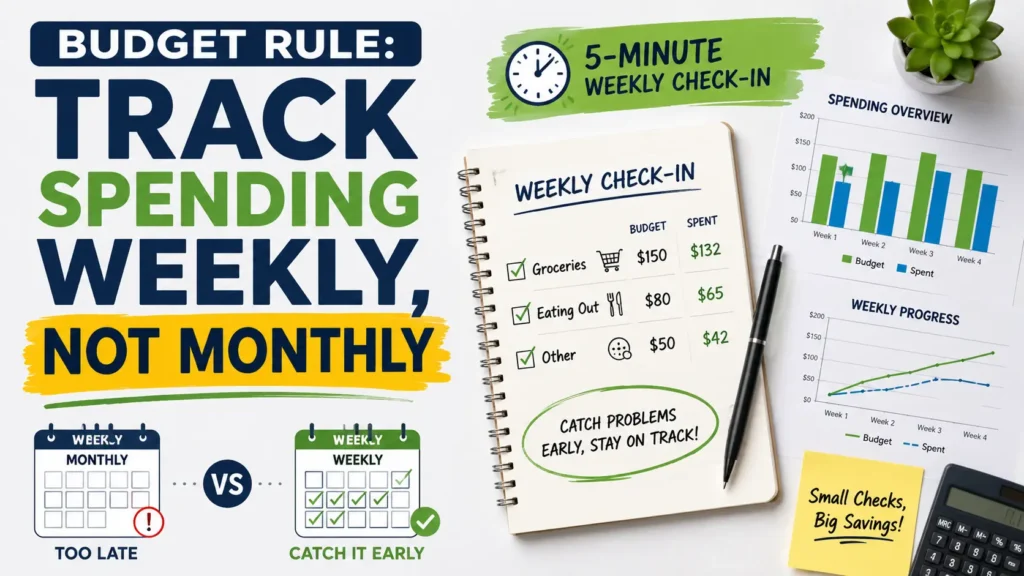
Monthly check-ins sound reasonable, but here’s the problem: by the time you realize you’ve overspent in week one, you’re often three weeks into the habit before you even look at the numbers again.
Instead, do a five-minute check-in every week. Just glance at what’s been spent versus what’s budgeted in your top two or three categories — usually groceries and eating out, since those tend to be where family budgets bleed the most. Catching a problem in week two is a lot easier to fix than catching it in week four.
Budget Rule #7: Give Every Dollar a Job — Including Fun Money
One of the fastest ways to sabotage a family budget is making it so restrictive that everyone feels deprived. That’s not sustainable, and it usually ends in a spending rebellion around month three.
Build in a small amount of guilt-free fun money for each adult in the household — money that doesn’t need to be justified or tracked line by line. It might only be $30 or $50 a month, but having it makes the rest of the budget feel a lot less like punishment and a lot more like a plan you chose.
Budget Rule #8: Review and Adjust Monthly, No Guilt Allowed
Your first month’s budget will be wrong. So will your second. That’s normal — you’re working with estimates until real data shows you where the actual numbers land. At the end of each month, sit down and compare what you planned against what actually happened, then adjust the next month’s numbers accordingly.
This is the step most families skip, and it’s the one that turns a budget from a one-time exercise into an actual system. There’s no prize for guessing everything correctly on the first try. The goal isn’t a perfect budget — it’s a budget that gets a little more accurate, and a little easier to live with, every single month.
The Bottom Line
A family budget that actually works isn’t the fanciest spreadsheet or the strictest set of rules — it’s the one that reflects how your family really lives, includes room for the unexpected, and gets reviewed often enough to stay useful.
Start simple. Know your real numbers, pick a method you’ll actually stick with, build in a cushion for life’s surprises, get your whole household involved, and check in regularly. Do that consistently, and the budget stops being a source of stress and starts being what it was always supposed to be: a plan that lets your family spend on what matters most, without the guesswork.
It won’t be perfect right away. Ours certainly wasn’t. But six months in, we weren’t guessing anymore — and that $600-a-month mystery gap? We found it, and we redirected it straight into our kids’ college fund instead.