Key Takeaways:
- The Hawkins test screens for shoulder impingement — one of the most common causes of shoulder pain
- Takes less than 60 seconds and requires zero equipment
- A positive result does not mean a rotator cuff tear — it just means something is irritated
- Sensitivity is 70 to 80 percent — good, but never used alone
- Most cases resolve with physiotherapy, not surgery
- Mild cases recover in 6 to 8 weeks — stubborn ones take 3 to 6 months
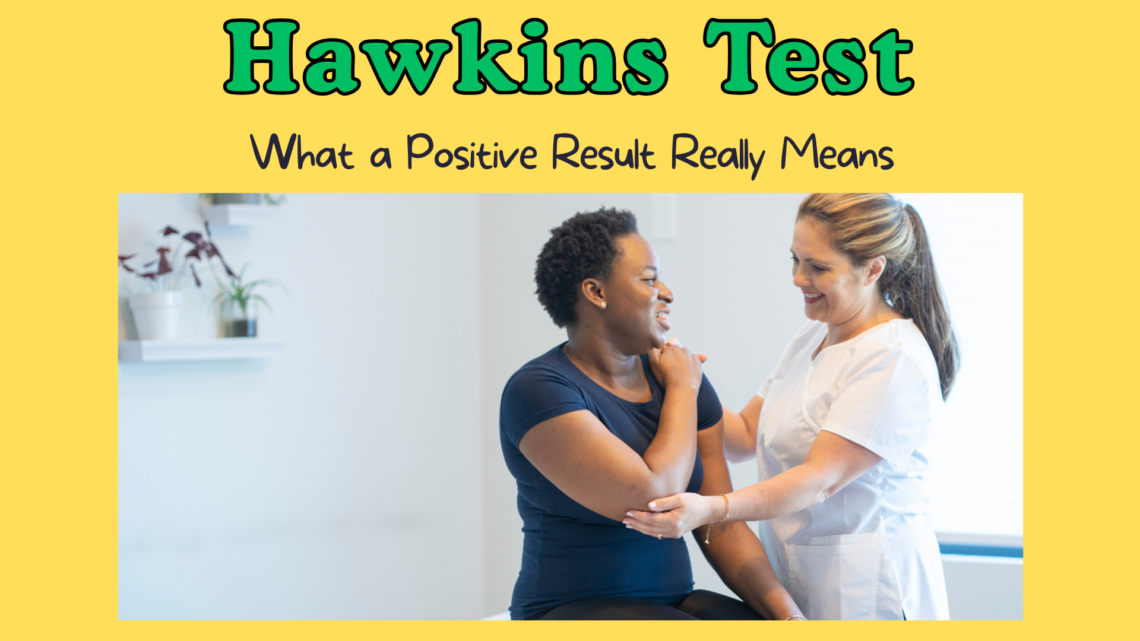
The Hawkins test is a quick physical exam where a clinician moves your arm into a specific position to compress the tendons inside your shoulder — if that movement recreates your familiar pain, the test is positive and suggests subacromial impingement.
That Shoulder Pain When You Reach Up
You grab something off a high shelf and feel it. A familiar, nagging ache right in the shoulder. Swimming, throwing, putting on a jacket — same thing every time.
If you’ve seen a doctor or physio about it, they probably did something called the Hawkins test. It took about 30 seconds. Someone moved your arm. You either felt pain or you didn’t.
Simple as it looks, it’s one of the most widely used shoulder tests in the world. But most people walk out of the clinic with no idea what it actually found — or what it means for them.
Here’s everything you need to know.
What Is the Hawkins Test?
It’s a physical screening test for subacromial impingement — a condition where the tendons inside your shoulder get pinched during arm movement.
First described in 1980 by orthopaedic surgeons Dr. Robert Hawkins and Dr. John Kennedy, it’s now a standard tool used by physiotherapists, sports medicine doctors, and orthopaedic surgeons worldwide.
The concept is simple. The clinician puts your arm in a position that briefly compresses the tendons inside the shoulder. If those tendons are already irritated or inflamed, the compression recreates your pain.
It doesn’t give a final diagnosis. It gives a strong signal about where the problem is coming from.
Why Shoulders Get Impinged
Your shoulder is the most mobile joint in your body — which also makes it the most vulnerable.
Inside the joint, your rotator cuff tendons and a small cushioning sac called the bursa run through a narrow channel called the subacromial space. Above that space sits a bony ledge called the acromion.
When everything is healthy, the tendons glide smoothly. When they swell or the bursa gets inflamed, the space tightens. Lift your arm and the tissues get pinched between the bones.
That’s impingement. That’s what this test finds.
How the Test Is Done
You sit or stand relaxed. The clinician lifts your arm forward to shoulder height — 90 degrees — with your elbow also bent at 90 degrees.
Then they rotate your arm inward by pushing your forearm down.
That movement drives the upper arm bone slightly upward, compressing the rotator cuff tendons against the acromion above.
If those tissues are irritated — you’ll feel it. Usually at the front or side of the shoulder. That’s a positive test.
Healthy shoulder? Usually just feels like mild pressure. Nothing dramatic.
What a Positive Result Actually Means
This is the part worth paying attention to — because a positive result causes more worry than it usually should.
A positive Hawkins test means something inside the shoulder is being irritated by compression. The most likely causes are:
Supraspinatus tendinopathy — irritation of the main rotator cuff tendon that lifts the arm.
Subacromial bursitis — the cushioning sac between the tendon and bone has become inflamed.
Biceps tendon irritation — the biceps tendon runs through the same area and can contribute.
What it does NOT mean — a rotator cuff tear. Mild inflammation and bursitis both produce a positive result. The Hawkins test alone cannot tell the difference between irritation and a structural tear. That’s what imaging is for.
This is why clinicians never rely on one test alone.
How Reliable Is It?
Sensitivity sits at around 70 to 80 percent — meaning it catches roughly 7 or 8 out of 10 genuine impingement cases. That’s solid for a quick hands-on test.
Specificity is lower — 50 to 65 percent — meaning some people without impingement also test positive.
This is exactly why your clinician combines it with other tests, your history, and sometimes imaging. One test alone is never enough to diagnose a shoulder problem confidently.
Hawkins Test vs Neer Test
These two are almost always performed together.
Both compress the rotator cuff tendons under the acromion — but at different points in the movement range.
The Neer test lifts the arm straight overhead and stresses the shoulder at its end range. The Hawkins test works at 90 degrees — the mid-range — catching irritation that might not show at full elevation.
Together they cover more ground. When both tests are positive, confidence in the diagnosis rises significantly.
| Test | Position | Sensitivity | Best For |
| Hawkins-Kennedy | 90° flexion, internal rotation | 70–80% | Mid-range impingement |
| Neer Test | Arm lifted overhead | 60–75% | End-range impingement |
| Painful Arc Test | Arm lifted sideways 60°–120° | High | Active impingement |
| Empty Can Test | Thumb-down elevation | Moderate | Supraspinatus injury |
What Causes Shoulder Impingement?
It rarely appears out of nowhere. Usually something has been building quietly for a while.
Repetitive overhead movement — swimmers, tennis players, painters, electricians, gym-goers doing a lot of overhead pressing. The tendons gradually get worn down.
Poor posture — rounded shoulders from desk work or phone use changes how the shoulder blade moves and reduces the subacromial space. Many people have no idea their posture is driving their shoulder pain.
Weak rotator cuff or shoulder blade muscles — when these muscles can’t do their job properly, the head of the upper arm bone drifts upward and compresses the tendons with every movement.
Age — tendons become less elastic over time. Shoulder impingement is much more common in people over 40.
Bone shape — some people are simply born with a curved acromion that leaves less room from the start.
What Happens After a Positive Test?
Your clinician will run additional shoulder tests and ask about your symptoms — when the pain started, what makes it worse, whether it disturbs your sleep.
Depending on findings, next steps may include:
X-rays — to check bone shape and look for spurs.
MRI or ultrasound — to see the soft tissues. Necessary if a rotator cuff tear is suspected.
In many cases treatment starts without imaging because shoulder impingement usually responds well to conservative care and imaging is most useful when things aren’t improving.
How Is Shoulder Impingement Treated?
The vast majority of cases resolve without surgery. Here’s how treatment typically progresses.
Physiotherapy is the cornerstone. A good physio doesn’t just treat the painful spot — they look at the whole movement pattern driving the problem. Treatment usually includes rotator cuff strengthening, shoulder blade stability work, and movement retraining.
Activity modification — temporarily reducing the overhead movements that aggravate the tendons while they settle.
Anti-inflammatories and ice — helpful for managing pain in the early stages.
Corticosteroid injection into the subacromial space — recommended when inflammation is significant enough to make rehabilitation difficult. A well-placed injection can reduce swelling enough to allow the strengthening work to actually progress.
Surgery — considered only after several months of proper conservative treatment haven’t worked. Most people never reach this point.
How Long Does Recovery Take?
Mild cases with consistent rehabilitation — 6 to 8 weeks.
More significant tendon irritation or bursitis — 3 to 6 months.
The most common reason recovery drags on is inconsistent exercise compliance, returning to provocative activities too soon, or failing to address the underlying cause — usually posture or muscle weakness — that drove the problem in the first place.
My Honest Take on MCT Oil for Weight Loss
Stockholm Syndrome Explained in Simple
Most Searched Questions
Is the Hawkins test painful? If you have real impingement, yes — it recreates your familiar shoulder pain. That’s the point. Healthy shoulders feel mild pressure at most.
Can I do the test on myself? No. The test requires your arm to be completely passive while someone else moves it. If your muscles engage, the result is unreliable.
Does a positive result mean a rotator cuff tear? No. Mild inflammation and bursitis both produce positive results. Imaging is needed to check for a tear.
Does a positive result mean I need surgery? Almost certainly not. Surgery is a last resort after months of failed conservative treatment.
Why does shoulder impingement hurt more at night? Lying on the affected shoulder compresses already irritated tissues. Even lying on the opposite side can be uncomfortable because the shoulder hangs in a position that stretches the inflamed area.
Is shoulder impingement the same as frozen shoulder? No. Impingement is about compressed, irritated tendons. Frozen shoulder involves the joint capsule tightening and severely restricting movement in all directions. Different conditions, different treatments.
Can I keep exercising with shoulder impingement? Usually yes — with modifications. Overhead movements, heavy pressing, and anything that reproduces the pain should be temporarily reduced. Most other training is fine to continue.
Can it come back after treatment? Yes — especially if the underlying causes like poor posture or weak muscles haven’t genuinely been fixed.
What’s the difference between impingement and a rotator cuff tear? Impingement means the tendons are intact but compressed and irritated. A tear means one or more tendons has partially or fully torn. Impingement left untreated can eventually progress to a tear.
The Bottom Line
A positive Hawkins test isn’t a disaster. It’s a clue — a signal that something inside the shoulder is being irritated and deserves a closer look.
In most cases that closer look leads to a clear diagnosis, a straightforward treatment plan, and a full recovery without surgery.
The shoulder is complicated. But impingement is one of the most treatable shoulder conditions there is. With the right physio, some postural awareness, and consistency with your exercises — most people get back to everything they were doing before the pain started.
If your result left you with more questions than answers, ask your clinician to walk you through it. Understanding what’s actually happening in your own shoulder makes the whole recovery process considerably easier to commit to.
This article is for educational purposes only and does not replace professional medical advice. Always consult a qualified healthcare provider for diagnosis and treatment of shoulder pain.