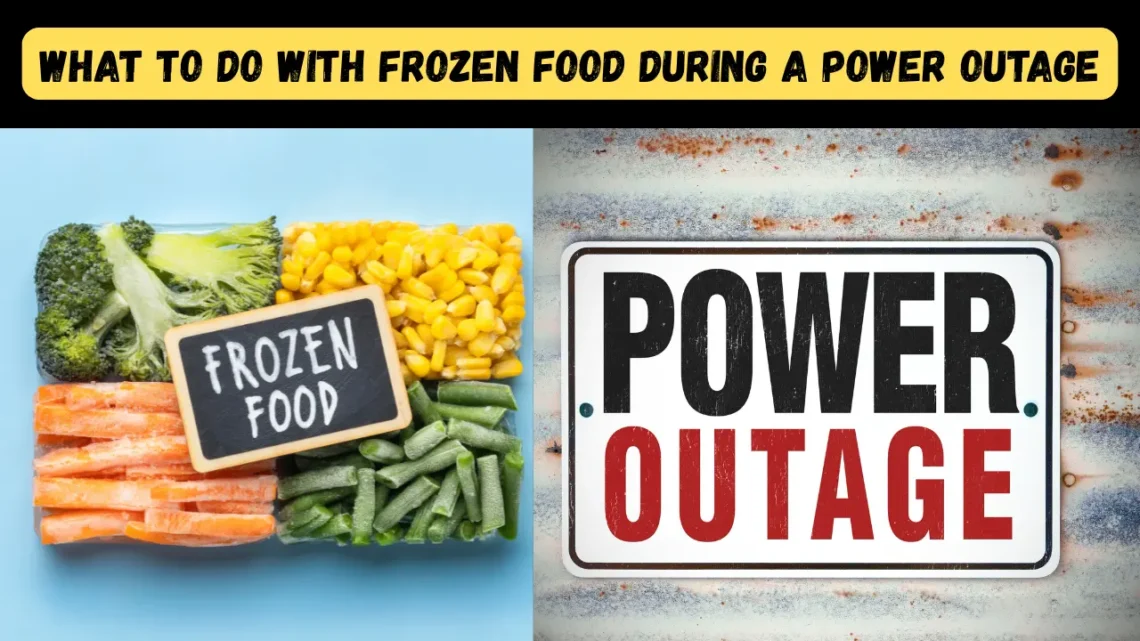
The power just went out. Your freezer is full of food. What do you do?
Most people panic and start throwing things away too quickly. Others wait too long and end up eating food that is no longer safe. Both mistakes cost money and create real health risks.
This guide gives you a clear, simple, step-by-step plan for exactly what to do with your frozen food and refrigerated food during a power outage — from the first hour all the way through to when the power comes back.
The First Thing to Do: Nothing
When the power first goes out, the best thing you can do is leave the freezer door closed.
This is the single most important piece of advice in this entire article.
A full freezer that stays closed will keep food frozen safely for 48 hours. A half-full freezer stays frozen for 24 hours. Every time you open the door, you let cold air out and warm air in, cutting that time down significantly.
The US Department of Agriculture (USDA) confirms these timeframes. So resist the urge to check on your food constantly. Close the door, leave it alone, and start planning.
How Long Will Your Food Stay Safe ?
Here is the basic breakdown you need to know:
Freezer
| Situation | Safe Time Without Power |
| Full freezer (door kept closed) | 48 hours |
| Half-full freezer (door kept closed) | 24 hours |
| Freezer with door opened frequently | Much less — do not do this |
Refrigerator
| Situation | Safe Time Without Power |
| Refrigerator (door kept closed) | 4 hours |
| Refrigerator with block of ice added | Up to 48 hours |
Your refrigerator is the more urgent problem. It loses safe temperature much faster than the freezer. After 4 hours without power and with the door kept closed, the food inside is at risk.
Hours 1–4: Assess and Act
During the first four hours of a power outage, take these steps in order.
Step 1 — Find Out How Long the Outage Will Last
Check your phone for news, contact your power company’s outage line, or look for updates from neighbors. Knowing whether this is a 2-hour outage or a 2-day outage changes everything about what you need to do.
If power will return within 4 hours, you almost certainly do not need to do anything except keep the doors closed.
Step 2 — Gather Ice
If the outage looks like it will last more than 4 hours, your priority is getting ice for the refrigerator.
Options:
- Use ice from your freezer (bag ice, ice cubes from the icemaker)
- Buy bags of ice from a gas station or store while they still have power
- Use dry ice if available — one important note on dry ice is below
Place ice directly into the refrigerator to keep it at a safe temperature (below 40°F / 4°C). A refrigerator thermometer is very useful here — keep one in your fridge as standard practice.
Step 3 — Identify Your Most Perishable Refrigerator Items
The items that go bad fastest without refrigeration are:
- Raw or cooked meat and poultry
- Fish and seafood
- Dairy products (milk, soft cheeses, yogurt, cream)
- Cooked leftovers
- Eggs (in the US, where they are washed and must be refrigerated)
- Cut fruits and vegetables
If you have a neighbor with power, a cooler with ice, or a cold outdoor temperature (below 40°F), move these items there first.
The Ultimate Guide to Long-Term Survival Food Storage
What to Do With the Freezer Food
Option 1 — Let It Ride (Best Option for Short Outages)
If the outage is expected to last less than 48 hours and your freezer is full, the simplest plan is to leave everything in the freezer with the door closed and wait it out.
Check the power status regularly. As long as power returns within 48 hours (24 hours for a half-full freezer), your frozen food should still be safe.
Option 2 — Add Dry Ice (Best Option for Extended Outages)
Dry ice is frozen carbon dioxide with a surface temperature of -109.3°F (-78.5°C). One block of dry ice can keep a full freezer frozen for 24–48 additional hours.
How to use dry ice safely:
- Place dry ice on top of the food inside the freezer — cold air sinks, so positioning it on top maximizes the effect
- Use thick gloves or tongs — dry ice will cause severe frostbite if it touches bare skin
- Do not store dry ice in an airtight space — it releases CO2 gas as it sublimates, which can be dangerous in enclosed rooms
- Do not place dry ice directly on glass shelves — the extreme cold can crack glass
Dry ice is available at many grocery stores, ice suppliers, and some gas stations. Call ahead to confirm availability before driving — during major power outage events, dry ice sells out quickly.
Option 3 — Cook Everything You Can
If the outage is going to last more than 48 hours, the smartest move is to cook as much of your frozen food as possible while you still have gas or an alternative cooking source.
Cooked food lasts longer than raw food even without refrigeration. And food you have cooked can also be preserved, shared with neighbors, or moved to a cooler more easily.
Cook in order of priority — most perishable first:
- Raw meats and poultry
- Fish and seafood
- Prepared meals that contain meat or dairy
- Vegetables and fruits (these last longer raw but can be cooked if needed)
Option 4 — Transfer to a Cooler With Ice
A high-quality cooler packed with ice can maintain safe temperatures for 24–48 hours or longer. If you have a large cooler and enough ice, you can transfer the most valuable or most perishable frozen items.
Pack the cooler as full as possible — air space reduces efficiency. A full cooler holds cold much better than a half-empty one.
The Refreezing Question: Can You Refreeze Thawed Food ?
This is the most common question people ask after a power outage. The answer is: it depends.
The USDA Rules on Refreezing
Food that still has ice crystals in it, or that has been kept at 40°F (4°C) or below: Safe to refreeze. The food is still in a partially or fully frozen state and has not entered the danger zone.
Food that has thawed completely but stayed at or below 40°F (4°C): Can generally be refrozen, but the quality will be noticeably lower — texture and flavor suffer when food thaws and refreezes. It is safe, but not ideal.
Food that reached above 40°F (4°C) for more than 2 hours: Do not refreeze. This food has entered the bacterial danger zone and is no longer safe to refreeze or eat without thorough cooking first.
Cooked food: If you cooked previously frozen raw meat during the outage, the cooked product can be refrozen once power returns.
Item-by-Item Refreezing Guide
| Food | Can Refreeze? | Notes |
| Meat with ice crystals remaining | Yes | Safe and acceptable quality |
| Fully thawed raw meat (kept below 40°F) | Yes | Quality reduced, but safe |
| Meat above 40°F for 2+ hours | No | Discard — do not eat or refreeze |
| Fish and seafood | Yes, if still cold | Discard if any off smell |
| Cooked leftovers (below 40°F) | Yes | Safe if kept cold throughout |
| Ice cream | No | Bacteria risk once melted — discard |
| Frozen vegetables (still cold) | Yes | Quality may be softer |
| Frozen fruit (thawed) | Yes — or use immediately | Make jam, smoothies, or cook it |
| Hard cheese (frozen) | Yes | Texture changes but safe |
| Bread and baked goods | Yes | No safety concerns |
| Nuts and grains | Yes | Very stable, almost no concern |
The Refrigerator: What to Save and What to Toss
After 4 hours without power and no ice added, your refrigerator has become an insulated cabinet at room temperature. Use this chart to decide what to keep and what to discard.
Discard After 4 Hours Above 40°F (4°C)
- Raw or cooked meat, poultry, and seafood
- Milk, cream, and soft cheeses (ricotta, cottage cheese, brie, cream cheese)
- Yogurt
- Cooked pasta, rice, and potatoes
- Casseroles, stews, and soups
- Custards, puddings, and any egg-based dishes
- Fresh pasta
- Opened mayonnaise (above 50°F / 10°C for more than 8 hours)
- Cut melon, tomatoes, and leafy salad greens
Generally Safe to Keep
These foods are safe to keep even after extended time without refrigeration:
- Hard and processed cheeses (cheddar, Parmesan, Swiss, Gouda)
- Butter and margarine
- Whole uncut fruits and vegetables
- Fruit juices (opened)
- Vinegar-based salad dressings
- Peanut butter, jelly, and jam
- Bread, rolls, and muffins
- Breakfast cereals
- Mustard, ketchup, and relish
- Whole uncut raw vegetables
- Fruit pies and cakes (without custard filling)
- Dried herbs and spices
- Hard-boiled eggs in the shell (up to 1 week)
When the Power Comes Back: What to Check
When the power returns, do not just assume everything is fine. Take these steps:
Step 1 — Check the temperature inside your freezer and refrigerator. A freezer thermometer tells you exactly what temperature the food reached during the outage. If you do not have one, place a cup of ice in the freezer at the start of any outage — if the ice is still solid when power returns, the freezer stayed cold enough.
Step 2 — Use the “still frozen or has ice crystals” test. Any food that is still frozen or still has ice crystals throughout can be considered safe to keep or refreeze.
Step 3 — Check for signs of spoilage. Unusual smell, slimy texture, or dramatic color change are signs to discard. When in doubt, throw it out — food poisoning is far more expensive and unpleasant than replacing groceries.
Step 4 — Do not rely on taste or smell alone for meat. Dangerous bacteria like Salmonella and E. coli do not always produce noticeable odors. You cannot always tell if meat is safe by smelling it.
Step 5 — Restock your ice. Once power is confirmed restored, restock your ice supply and replace any dry ice with regular refrigeration.
How to Be Better Prepared Next Time
Every power outage teaches the same lesson: a little preparation makes a huge difference.
Keep a freezer thermometer inside your freezer at all times. A basic appliance thermometer costs about $5 and gives you immediate, accurate information when you need it most.
Keep your freezer as full as possible. A full freezer holds cold much longer than a half-empty one. If your freezer is half-empty, fill the space with containers of water that can freeze into solid blocks of ice. This free trick dramatically extends your safe storage time.
Own at least one high-quality cooler. A good insulated cooler is one of the most useful pieces of emergency equipment any household can have. Quality coolers can hold ice for 24–48 hours or more.
Know in advance where your nearest dry ice supplier is. During a major regional power outage, dry ice can be sold out within hours. Having a plan before the emergency saves critical time.
Learn basic food preservation techniques. Salt curing, smoking, drying, wax preservation, and other no-refrigeration methods reduce your dependence on electricity entirely. Every food you know how to preserve without power is one less thing to worry about when the lights go out.
Frequently Asked Questions (FAQ)
Q: My power went out overnight and I did not know. Is my freezer food still safe?
Check whether the food still has ice crystals or feels very cold. If the freezer was full and stayed closed, food likely stayed safe for up to 48 hours. Check each item using the guidelines above and use your best judgment. When in doubt, throw it out.
Q: Can I put warm cooked food in the cooler or freezer during an outage?
Let cooked food cool to room temperature first before putting it in a cooler or freezer. Warm food raises the temperature inside the cooler and speeds up ice melt, putting all the other food at risk.
Q: What temperature is the bacterial danger zone for food safety?
The danger zone is between 40°F and 140°F (4°C and 60°C). Bacteria multiply rapidly in this range. Keep cold foods below 40°F and hot cooked foods above 140°F at all times.
Q: How long can I leave ice cream out before it has to be thrown away?
Ice cream should be discarded once it melts completely, even if it is refrozen later. The texture and bacterial safety of fully melted and refrozen ice cream are both compromised. It is one of the most commonly overlooked foods to discard after a power outage.
Q: Is it safe to eat food that smells fine but was above 40°F for several hours?
Not reliably. Dangerous bacteria like Salmonella, E. coli, and Listeria do not always produce noticeable odors. The USDA rule is clear: when in doubt, throw it out.
Q: What if it is winter and the temperature outside is below freezing?
You can use the outdoors as a natural freezer — but only if temperatures stay consistently below 32°F (0°C) throughout. Be aware that temperatures can fluctuate and that sunlight can warm things up quickly during the day. Also be cautious about animals getting into food left outside.
Final Thoughts
A power outage does not have to mean a full freezer of wasted food and hundreds of dollars thrown away. With a calm head and a clear plan, you can protect most of your food supply through almost any outage.
The key rules are simple: keep the freezer door closed, know your timeframes, get ice for the refrigerator early, cook what you can if the outage is long, and never guess about meat and seafood safety.
The best preparation is the kind you do before the emergency. A full freezer, a good appliance thermometer, a quality cooler, and the knowledge in this article put you far ahead of most people the moment the lights go out.